Explore Beijing / Beijing Summer Camps and Short-Term School Options for Visiting Kids
Beijing Summer Camps and Short-Term School Options for Visiting Kids
Camps yes, school enrollment nearly always no: what visiting families can actually book, what the 2022 rules require, real camp prices and paperwork, and where to base.
8 min read · KOULING's Beijing Travel Guide
A two-to-four-week Beijing trip with school-age kids raises a question many visiting families never quite resolve: can the children actually spend part of the trip in a classroom or a camp, rather than trailing parents between temples? The short answer is yes for camps and classes, and almost always no for real school enrollment - but the boundary between the two is where most of the confusion lives. This guide maps what is genuinely bookable on a visitor's timeline, what the official rules say, what a week of camp costs, and where to base the family while it all happens.
Start here: what is actually possible on a trip
Beijing has two parallel systems. The first is formal schooling: international schools and the international divisions of local schools, which admit foreign-passport children as enrolled students. The second is everything that looks like school but is not degree education: Mandarin-language camps, sports camps, university-based summer programs, and private daycare. Visiting families almost always belong to the second system. Real enrollment in a school normally requires admission paperwork issued before you enter China plus a study visa, and schools are not set up for two-week drop-ins. Camps and training centers, by contrast, are businesses that deal with short-stay international families every summer.
What the official rules say about short-term study
Beijing's 2022 rules on enrolling international students in kindergartens and primary and secondary schools define short-term study as 180 days or fewer and longer stays as long-term study. Three requirements matter even for short stays. The child must travel on an ordinary passport. If the parents are not resident in Beijing, a resident guardian must be formally appointed with a notarized birth certificate and guardianship letter. And group short-term study - a school class coming over together - must be arranged through a signed agreement between the school and the sending organization, with a group leader acting as guardian. A family arriving independently is outside all of these scenarios, which is precisely why camps, not schools, are the realistic path [verify]. 中国官方文件《北京市幼儿园、中小学招收和培养国际学生管理办法》(2022) is the source document.
The four kinds of programs visiting families actually use
Most bookable options fall into four buckets, and knowing which one you are in tells you what the paperwork looks like.
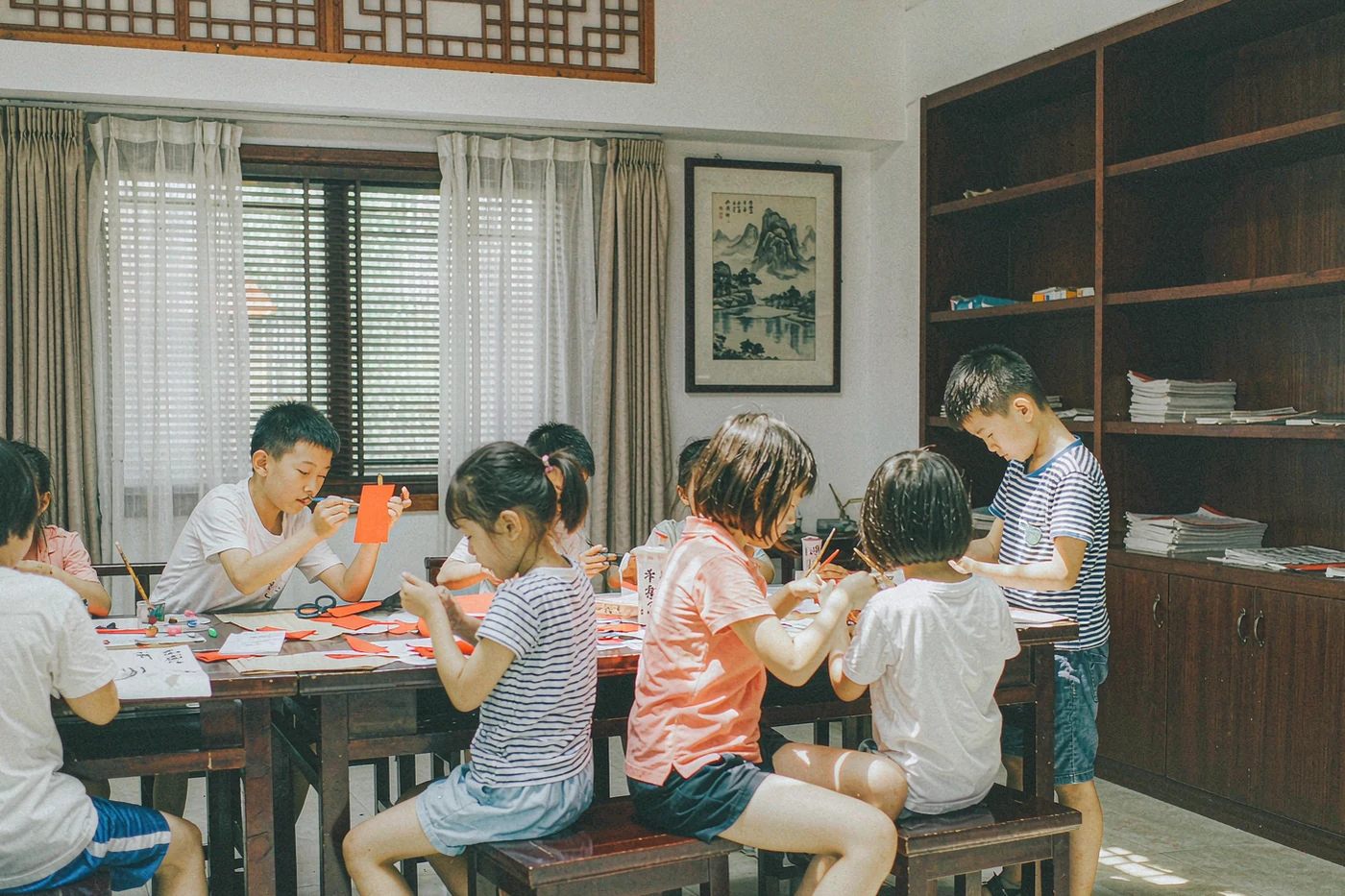
Mandarin and culture camps — Half-day or full-day language classes plus calligraphy, cooking, hutong walks and excursions. The largest operators run year-round from campuses near Dongzhimen and in the university district.
Residential campus programs — Multi-week programs hosted on or near university accommodation with counselors, meals and weekend trips. Suited to teens travelling semi-independently while parents work or travel.
Sports and themed day camps — Basketball, kung fu, art and drama weeks, mostly domestic-market providers with lower prices and Mandarin-heavy environments.
Daycare and kindergarten for under-6s — Private international daycare centers that accept foreign children by the term or month, with weekly or fortnightly arrangements sometimes negotiable directly.
What a Beijing camp actually costs
Published 2026 prices from established operators give a realistic band; treat every figure as a starting point and confirm at booking [verify].
Half-day language camp, 2 weeks — About 9,000 yuan (camp materials included, lunch and activities not). Suits families who want mornings structured and afternoons sightseeing together.
Full-day camp, 2 weeks — About 17,000 yuan with lunch, cultural activities and excursions. Ages roughly 10-17 at the big language-school operators.
Residential program, 2 weeks — About 30,000-32,000 yuan all-inclusive with meals, evening activities and airport transfer; university-based 16-day programs quote around 28,800 yuan. Typically ages 8-17.
Domestic-market sports and English camps — About 7,980-9,980 yuan for 6-7 days. Cheapest per day, but teaching language is mostly Mandarin and English support varies.
Under-6 daycare — International daycare quotes run 100,000-120,000 yuan per school year, with monthly rates around 16,000 yuan; short-stay weekly rates are negotiated case by case.
Booking timeline and paperwork
Good camps in July and August do fill up, and the paperwork has a long pole: the child's passport.
2-3 months out — Shortlist two or three operators, check session dates and age ranges, and ask whether the child needs a placement test for language level.
At booking — Pay the deposit, upload the passport bio page, and provide allergy, medication and emergency-contact details. Ask whether travel medical insurance is required - most operators insist on it.
2-4 weeks out — Confirm the daily schedule, drop-off and pick-up times, lunch arrangements, and what to bring (water bottle, sun hat, spare clothes for younger kids).
Before the first day — Register your family's accommodation within 24 hours of arrival - hotels do this automatically; a rented apartment means a trip to the local police station with the child's passport.
During the camp — Most international-facing camps run a daily parent group on WeChat with photos; ask for it if it is not offered.
Visas: what covers camp attendance
Citizens of more than 50 countries can enter China visa-free for up to 30 days, which comfortably covers a one-to-three-week camp; other nationalities use a standard tourist (L) visa. Camps and training centers are non-degree education, and established operators routinely accept visiting children on visa-free entry or a tourist visa - but this is the operator's standing practice, not a written entitlement, so ask directly before paying [verify]. Formal school enrollment is different: it requires an admission notice and district-education filing that support an X2 study visa issued before you enter China, plus proof of guardianship if neither parent is resident. If any school tells you a child can start classes in a week on a tourist visa, treat it as a red flag.
Where camps happen, and where to base the family
Location quietly decides how much of the experience survives the commute.
Dongzhimen and Lido (Chaoyang) — The classic expat corridor: language-school campuses, international clinics and Western groceries within a few stops. Line 2 and Line 13 meet at Dongzhimen; Line 14 serves the Lido area.
Wudaokou and the university belt (Haidian) — University-based residential programs cluster here. Line 13 Wudaokou, quick Tsinghua and Peking University access, but further from the main sightseeing loop.
Shunyi (northeast) — Where most international schools sit, alongside the airport. Spacious and quiet, but 45-75 minutes from the city center - works if the camp is on-site.
Under-6s: daycare and drop-in realities
Preschool-age children are the awkward middle case. Formal kindergartens, including the international divisions of public schools, follow the same enrollment and visa rules as schools and do not take short-term visitors. Private international daycare centers are the workable option: several in Wangjing, Lido and Shunyi accept foreign toddlers, teach in mixed Chinese-English classrooms, and will quote by the month or, occasionally, the fortnight [verify]. Expect to pay a meaningful share of full-term fees for a partial stay, and expect a settling-in week - three-year-olds do not care that you have sightseeing planned. An honest alternative for very short trips: parent-child activity classes (music, gym, art) that sell single sessions, widely available in shopping malls across Chaoyang and Haidian.
Practicalities parents ask about first
The small print that decides whether camp week is a success.
Hours — Day camps typically run 09:00-15:30 or 09:00-16:30 with lunch included; half-day versions end before lunch [verify].
Summer heat — July and August mean 30-35 degree Celsius afternoons and sudden heavy rain. Indoor-heavy schedules and a 14:00 heat break are signs of an experienced operator.
Lunch and allergies — Chinese camp lunches are standard fare; nut and dairy allergies need a written note and a confirmation call, not a checkbox.
Communication — The camp will contact you through WeChat, not email. Set up WeChat before arrival and add the camp coordinator on day one.
Money — Kids do not carry cash or payment apps in China. Pack a transit card or arrange pick-up, and hand over pocket money only for camps that manage it officially.
Certificates — Most camps end with a completion certificate and a small graduation ceremony - worth it for the photo, useless for school credit. Keep expectations calibrated.
Book the passport first — A child passport with less than six months' validity will fail camp check-in and visa checks alike; renew before you book anything.
Ask about nationality mix — Camps marketed globally can be 90 percent Mandarin learners from one country; if a mixed international peer group matters, ask for last summer's roster profile.
Verify pick-up logistics — Ask who is allowed to collect the child and what ID they must show - reputable camps log every handover.
Pair the camp with sightseeing — Morning camp plus one afternoon outing is the sustainable rhythm for 6-10-year-olds; full-day camp plus evening sightseeing burns kids out by Wednesday.
Confirm the refund terms in writing — Wellness issues and flight changes happen; ask what happens to the balance if the child misses a week.