A fever on day three? How visiting families get pediatric care in Beijing - which international clinics treat foreign kids, what visits cost, how to book without a Chinese phone number, and how vaccine catch-up works.
A fever at 9 p.m. on day three of your Beijing trip rewrites the itinerary faster than any weather forecast. The reassuring part: Beijing has the deepest pediatric bench in northern China - English-speaking international clinics built around families, two top-tier public children's hospitals, and pharmacies that cover the mild end of the spectrum. This guide explains how visiting parents actually use them: where a feverish toddler should go, what a consultation costs, how to book without a Chinese phone number, and how vaccine catch-up works mid-trip.
Beijing pediatric care comes in three tiers, and choosing correctly saves both money and hours of queuing. For a routine illness - a fever, an earache, a cough that will not quit - an international clinic gives you a calm, English-speaking appointment for roughly the price of a nice dinner. For anything complex or surgical, the public children's hospitals employ specialists who see volumes no private clinic can match. For the sniffles, a pharmacy plus your hotel's help is often enough.
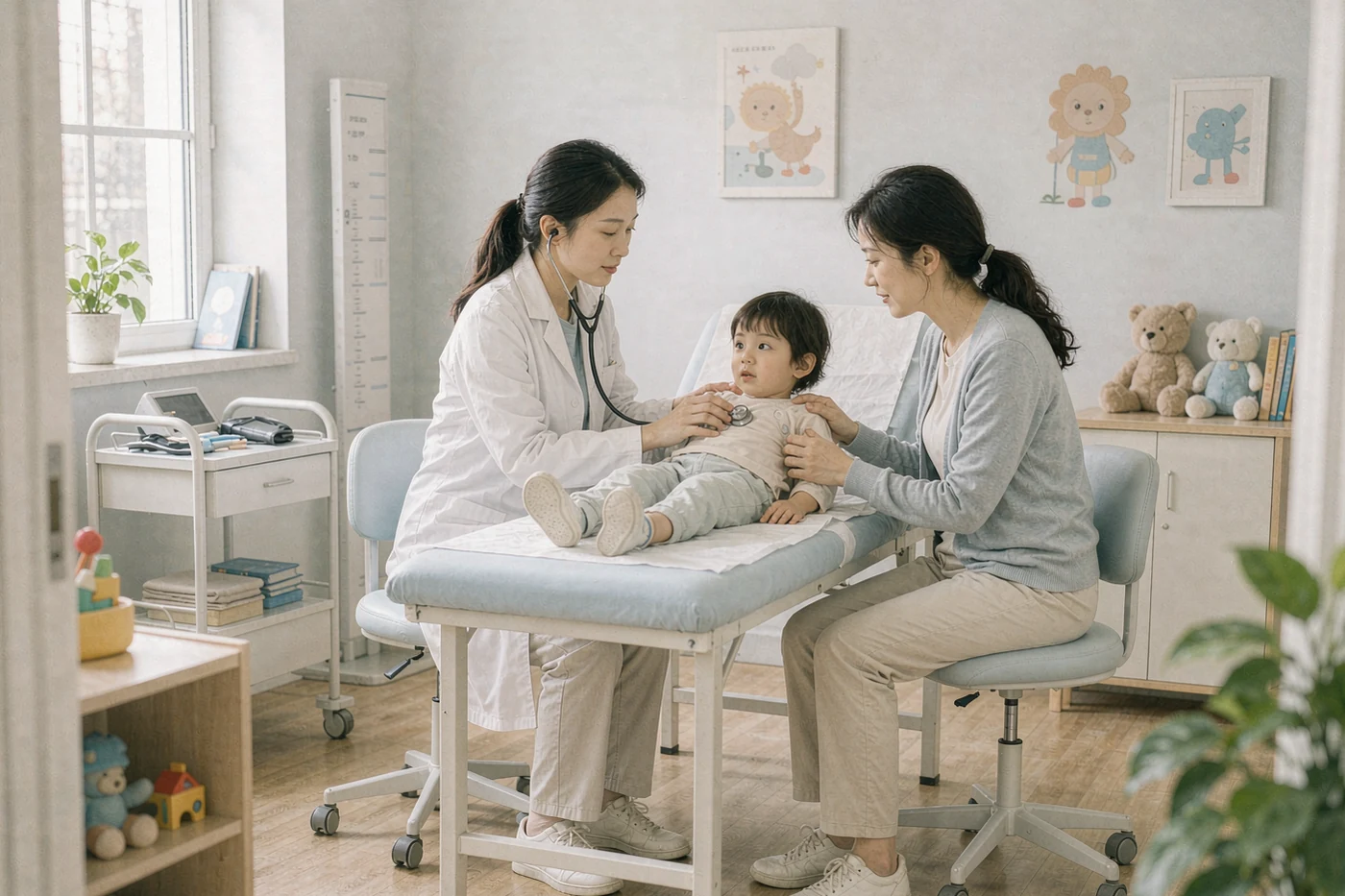
Beijing United Family Hospital (北京和睦家医院) in Chaoyang is the heavyweight: a JCI-accredited hospital with a 24/7 emergency department, a dedicated pediatrics department, and staff used to foreign families. Its main campus is at 2 Jiangtai Road, a short walk from Jiangtai station on Line 14. Raffles Medical Beijing near Liangmaqiao is a smaller clinic known for quick appointments, and Global Doctor has branches across Chaoyang, Haidian and Shunyi. All three handle urgent walk-ins to varying degrees, but pediatric outpatient visits should be booked ahead; United Family's English service line is 4008-919-191 [verify].
You do not need a Chinese app or a mainland phone number to see a pediatrician at an international clinic - a phone call or an email works, and reception registers your child under the passport. Bring the child's passport, your own, and any prior medical notes or discharge letters. Chinese ID is not required; a passport is the standard identity document at these clinics. If your travel insurance offers direct billing, call the insurer before the visit: clinics only extend direct billing with pre-authorization, otherwise you pay out of pocket and claim afterwards with itemized invoices.
Beijing Children's Hospital (北京儿童医院) in Xicheng, served by Fuxingmen station on Lines 1 and 2, and the Capital Institute of Pediatrics children's hospital (首都儿科研究所附属儿童医院) in Chaoyang are where Chinese families go for anything serious, and foreign visitors can use both - passports are an accepted identity document at the registration window. The systems are Chinese-first: Beijing Children's Hospital has run full appointment-based registration since 2015, with a real-name QR code created at the on-site window on your first visit. The Capital Institute hospital releases booking slots at 15:00 for roughly the next two weeks through its WeChat account and the Beijing 114 platform (phone 010-114). Both run evening clinics until late at night plus 24-hour emergency departments where you register on the spot. The apps and hotlines mostly expect a Chinese phone number, so the realistic routes for visitors are the emergency center for urgent care, or asking hotel staff to grab a same-day evening slot.
Some symptoms should not wait for a morning appointment. Go straight to a 24-hour emergency department - United Family's ER, or the emergency center at either public children's hospital - if your child has any of the following. For an ambulance in Beijing, call 120; international clinics can dispatch English-speaking ambulances [verify].
China's national immunization program differs from US, UK and European schedules - it includes a tuberculosis (BCG) shot and a Japanese encephalitis vaccine that most Western schedules do not, and the timing of other doses varies. For a trip of a few weeks this almost never matters: your child does not need catch-up shots to travel safely in Beijing. What does matter is carrying the immunization booklet (the yellow card or its equivalent), because previous doses change the treatment if your child needs rabies or tetanus protection after a wound. International clinics such as United Family can vaccinate according to your home schedule if a course was interrupted; expect private-pricing vaccine costs on top of the consultation [verify].
International clinic pricing is the shock line on the bill; public hospitals are the opposite. As a rough planning range [verify]: a GP or pediatric consultation at an international clinic runs CNY 600-1,200, specialist visits cost more, and an ER evaluation starts around CNY 1,900. Public children's hospitals charge a standard outpatient service fee in the tens of yuan - a fraction of private care - with tests and medicine billed separately at similarly low prices.
Most childhood travel illness is mild: a low fever, a sensitive stomach, a dry throat from Beijing's heated winter air. Chinese chain pharmacies stock children's versions of the two fever medicines you likely know - ibuprofen (ask for Meilin, 美林) and paracetamol (Tuonuolin, 泰诺林) - as suspensions dosed by weight. Dosing is weight-based, not age-based: tell the pharmacist your child's weight in kilograms and let them set the dose rather than guessing from the package. If symptoms run past two or three days, or a fever climbs above 39 C, escalate to a clinic instead of rotating medicines.