Passports for every guest, deposits, 大床房 versus 双床房, the card slot that runs the lights, 220 V power, the six toiletries Beijing hotels no longer put out, and how check-out really works.
Your first ten minutes in a Beijing hotel room go much better if you know the script in advance. The desk will ask for every passport in the party, not just yours. The room card is what switches the lights on. The bathroom may have no toothbrush, and that is municipal policy rather than stinginess. Heating and air conditioning change over on dates set by the city, not by the weather you happen to arrive in. None of this is difficult, and none of it is a problem once you have read it once. This guide walks the whole thing in the order you will meet it: the desk, the room, the switches, then check-out.
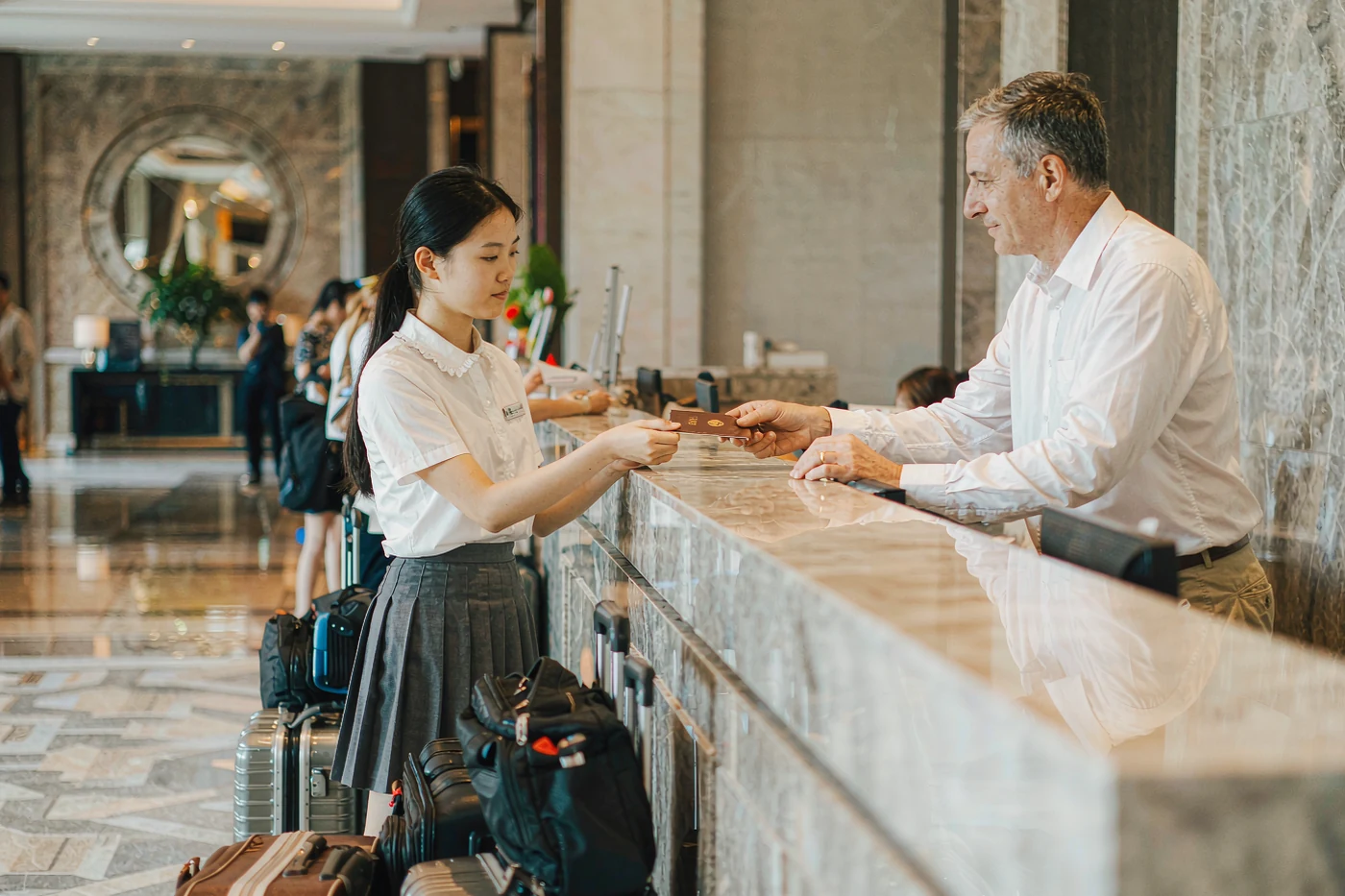
Chinese hotels are legally required to register every guest with the public security system, and for foreign guests that means the physical passport — not a photo of it, not a driving licence, not the name on the booking. Every person in the room is registered individually, including children and infants. Budget two passes of the passport across the scanner, and expect the receptionist to look at your visa page as well. This is why check-in with a family takes ten minutes instead of two. Some hotels also ask for your visa type and where you stayed last night; if you have just landed, that is the answer they want.
Most mid-range and independent hotels in Beijing take a deposit at check-in. A few hundred yuan is the common range — think roughly ¥200 to ¥500 — and it is not a charge. Chains increasingly take it as a card pre-authorisation rather than cash, which means the money is held rather than taken, and it releases on its own within a few days to a couple of weeks depending on your bank. If you pay cash, count the notes back at the desk and keep the slip, because that slip is what you hand over at check-out to get them back. International chains and higher-end properties often skip the deposit entirely for card-holding guests. Whatever the figure, it should be stated before you agree to it.
Beijing hotel listings run on a vocabulary that does not map neatly onto Western room names. 大床房 (dà chuáng fáng) is the big-bed room, usually one bed between 1.5 m and 1.8 m wide. 双床房 (shuāng chuáng fáng) is the twin: two beds around 1.2 m each. 三人间 is a triple, common in family hotels and rarer in business ones. The trap is that a double room on some booking sites means a room for two people rather than a room with a double bed, so a couple booking blind can end up in a twin. If the bed matters, confirm 一张大床 — one big bed — before you take the cards. Bed length is the other surprise: a 1.8 m bed is 1.8 m wide, and the length is usually around 2 m.
In most Beijing hotel rooms the lights and air conditioning run only while a card sits in the slot by the door. That is an energy-saving measure, not a fault. Leave a card in the slot when you go out and the room stays cool — exactly what you want in July. The consequence people trip over is that nothing charges while you are out, unless you find the sockets that stay live. Many rooms have one or two always-on sockets near the desk or bedside, and finding them on the first night is worth the thirty seconds. The card's other job is the lift: in plenty of newer hotels and serviced-apartment buildings you must tap the card at the lift panel before it will let you press a floor button, and it will usually offer only your own floor.
China runs on 220 V at 50 Hz. If you are arriving from a 110 V country, check the label on your charger rather than the shape of the plug. Almost every modern phone, laptop and camera charger is rated 100–240 V and needs only a physical adapter; hair straighteners, curling irons, travel kettles and some older shavers are single-voltage and will die dramatically. Beijing hotel sockets commonly take the flat two-pin US-style plug and the angled three-pin Australian-style plug, and rooms built or refurbished in the last decade usually have at least one universal socket that swallows almost anything. USB-A ports on the bedside panel are common, USB-C less so. A short extension lead and a power bank will serve you better than a bag of adapters.
Beijing's statutory heating season runs from 15 November to 15 March, and the city can bring it forward or extend it when the weather justifies it — the trigger the municipal authorities use is several consecutive days with average outdoor temperature below 5 °C. Inside that window, rooms get heat whether or not you touch anything. Outside it, a hotel with central air conditioning may be running cooling only, or nothing at all, and a cold snap in late October or late March is a genuinely chilly few days in a room with no heat. The design standard for Beijing is an indoor temperature of at least 18 °C during the heating season. The control on the wall may be labelled in Chinese only, so learn two characters: 热 is hot, 冷 is cold. In older properties the radiator under the window has its own valve, and that is the thing that actually works.
Every Beijing hotel room has an electric kettle and you will use it. Tap water here leaves the treatment works meeting national drinking-water standards, but the network and the building pipework mean it is not intended to be drunk straight from the tap, so the kettle is the standard route to safe water: bring it to a full rolling boil and you are done. Since May 2020, Beijing hotels have been prohibited from proactively placing six disposable items in rooms — toothbrush, comb, bath scrubbing cloth, razor, nail file and shoe shine cloth. That is municipal waste-reduction policy and it applies to hotels of every grade, not a sign that your hotel is cutting corners. All six are still available; you ask at the front desk and they are brought up, usually within minutes and free of charge. Towels, slippers, soap and shampoo are still normally in the room.
Smoking is far more common in China than in most of the West and hotel rooms are no exception. A non-smoking room, 无烟房, is a request rather than a guarantee, and in older properties the non-smoking floor may still carry the smell. If you are sensitive, say so at the desk and ask to be moved while your bags are still at the door — moving after you have unpacked is a much harder conversation. Noise is the second one. Chinese hotels are often built with hard surfaces and light doors, and corridor noise late at night is the most common complaint from foreign guests. Two sentences fix most of it: ask for a room away from the lift, 不要靠近电梯, and on a higher floor, 高一点的楼层. Neither is an unusual request.
Ground floor is 1层, shown as 1F in the lift, and it is called the first floor — so British and European visitors do not need to add one, and neither do Americans. Below that, B1 and B2 are the basement levels, which is where breakfast, the gym, parking and sometimes a small shop live. Some buildings skip floor numbers considered unlucky; 4, 13 and 14 are the usual omissions, so a panel that goes 12, 15, 16 is not broken. Lift capacity is generous on paper and optimistic in practice — at breakfast time and around 18:00 in a hotel hosting tour groups, allow a few extra minutes. In serviced-apartment blocks and many newer hotels the lift needs your room card before it will show your floor, which is a security feature rather than a problem.
Standard check-out at most Beijing hotels is 12:00, with a growing number of chains offering 14:00, and the time is printed on the card sleeve or in the folder on the desk. Late check-out is usually available and usually priced: staying until around 18:00 commonly costs about half a night, and beyond that a full night. Ask in advance, and ask at the desk rather than in the app — the person in front of you can approve it, the app generally cannot. Left luggage after check-out is routine and free at almost every hotel, and it helps to say whether you are coming back for the bags the same day. If you need a receipt for expenses, ask for a 发票 (fāpiào) at check-out rather than at check-in; it takes a couple of minutes and, for a Chinese company, you will need their exact registered name and tax number.
If you found this useful, these cover the next question most visitors ask: