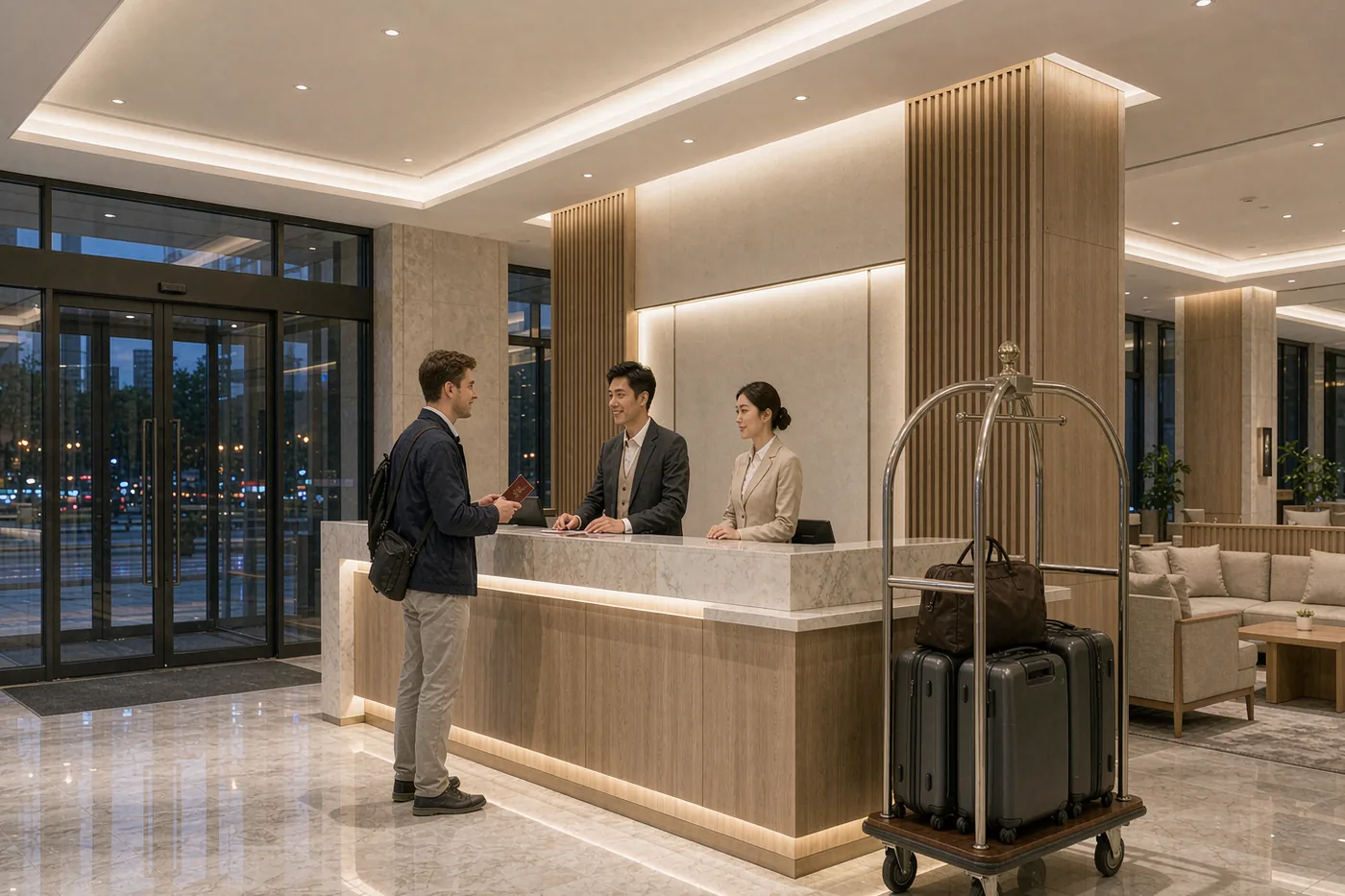
A plain-English guide to China's biggest hotel groups — what a CNY 150 Hanting room, a CNY 400 Ji room and a CNY 600 Atour room actually get you, and how they compare to Holiday Inn, Marriott or Hilton.
Most hotels in Beijing belong to a handful of huge Chinese chains, and the names on the signs — Huazhu, Atour, Hanting, Ji, HanYou, Orange, CitiGO — can look like alphabet soup to a first-time visitor. Here's the decode: Huazhu Group (branded internationally as H World) is the parent company that owns budget Hanting, mid-scale Ji and HanYou, and upscale-leaning Atour (technically a separate listed company in which Huazhu holds a stake). If you've ever stayed at an Ibis, the business model will feel familiar — standardized rooms, reliable basics, app-first booking — but at noticeably lower prices. A clean, air-conditioned, well-located room can cost as little as CNY 150–250 (roughly US$21–35) per night [verify before travel], which is why many Western travellers skip the international brands entirely.
Hanting (汉庭) is Huazhu's budget workhorse, and HanYou (海友/你好酒店) sits just below it. Expect a compact but genuinely clean room: firm bed, air conditioning, a small desk, free Wi-Fi and usually free bottled water. Bathrooms are typically wet-room style with a wall-mounted shower; toiletries are basic, and extras like slippers and a kettle may be minimal at the lowest rates. Staff English is hit-or-miss — in central and business districts you'll often find someone who can help, but don't count on it. At CNY 150–250 (US$21–35) per night [verify before travel], this tier replaces what you'd get from a Motel 6 or Travelodge, not a Holiday Inn. Trade-offs to accept: thinner walls, smaller rooms (often 15–20 sq m / 160–215 sq ft), no gym, and breakfast usually only offered at extra cost (CNY 20–40 / US$3–6 [verify before travel]).
Ji Hotel (全季, 'Quanji') is the tier most Western business travellers should target. Rooms step up to 25–30 sq m (270–325 sq ft), with better bedding, blackout curtains, a proper rainfall shower, quality toiletries and a generally calmer design aesthetic — think muted wood tones and warm lighting. Orange Hotel (桔子) and Orange Crystal are Huazhu's design-forward equivalents, often slightly more playful in style. At CNY 350–500 (US$49–70) per night [verify before travel], Ji sits below a Hampton Inn or Holiday Inn Express in price while matching or exceeding them in room quality. English at the front desk is more dependable at this level, and breakfast buffets (when included) are typically a solid mix of Chinese dishes with some Western staples like toast, eggs and coffee. Staff may still struggle with complex requests — booking taxis, luggage storage and printing are usually fine; navigating special diets may not be.
Atour (亚朵) is China's standout mid-to-upscale lifestyle brand, and it's the closest thing to a boutique hotel at chain prices. Rooms run 30+ sq m (325+ sq ft) with excellent mattresses (Atour sells its own bedding brand), deep bathtubs or large walk-in showers in many rooms, a gym at most locations, a 24-hour self-service laundry room at many properties, and a lobby that doubles as a reading lounge with free tea. The signature 'deep sleep' pillow menu is a genuine differentiator. Expect CNY 550–800 (US$77–112) per night in central Beijing [verify before travel] — comparable to a Courtyard by Marriott or Hilton Garden Inn room (US$130–180) but usually better designed. English capability varies by property; flagship locations near business districts and tourist hubs tend to have at least one English-capable staff member. Atour's loyalty program and app are Chinese-language-first, so booking through an OTA like Trip.com or Booking.com is often easier for foreigners [verify before travel].
Western-branded hotels (Holiday Inn, Marriott, Hilton, Hyatt, IHG) still earn their premium in specific cases: when you need fluent English front-desk service, when your foreign credit card is the only payment method you have, when you want a guaranteed gym/pool/club lounge, or when corporate policy requires an international chain. Rates in Beijing typically run CNY 700–1,500 (US$98–210) per night [verify before travel].
This is where Chinese and Western chains differ most. Chinese chain hotels are app-first: Huazhu's own app and WeChat mini-programs drive the cheapest rates, but they generally require a Chinese phone number and often a Chinese payment method (Alipay or WeChat Pay — both now accept foreign cards [verify before travel]). International OTAs like Trip.com, Booking.com and Agoda list most chain properties with English interfaces and accept foreign cards, usually at a small markup. Pay-at-hotel vs prepay options vary; prepay is often cheaper. Always confirm the cancellation deadline in Beijing time (China Standard Time, UTC+8).