Explore Beijing / Hiking Beyond Beijing: Baihe Canyon, the Water Great Wall, and Why Jiankou Is Off Limits
Hiking Beyond Beijing: Baihe Canyon, the Water Great Wall, and Why Jiankou Is Off Limits
The honest version of a Beijing hiking day: why the famous wild-wall sections such as Jiankou are illegal to climb and have killed people, and what to do instead — the legal Great Wall that stands in water at Huanghuacheng, and the canyon walk through Baihe that delivers the same drama without breaking the law.
11 min read · KOULING's Beijing Travel Guide
Search Beijing hiking and you will find the same photographs: a crumbling stretch of Great Wall on a knife-edge ridge, no handrails, nobody else in shot. The wall in those photographs is almost always Jiankou, and it is illegal to climb. This guide starts with that, because it is the thing visitors are most likely to be misled about. It then gives you the two trips that actually work and are actually legal: the Great Wall at Huanghuacheng, where the reservoir has put three sections of Ming wall into the water, and the Baihe Canyon, a river walk between hundred-metre cliffs that locals rate as one of the three great gorges near Beijing. Both are reachable without a car if you accept an early start, both are cheap, and neither will get you fined.
First, the part people get wrong: you cannot climb the wild wall
Jiankou is not a hidden gem. It is an unopened heritage site with a body count, and climbing it is prohibited by name.
What the law says — The national Great Wall Protection Regulation, in force since December 2006, prohibits organised activities on Great Wall sections not opened to visitors. Beijing's own Great Wall protection measures go further and explicitly prohibit climbing any section not approved as a visitor site — that prohibition covers individuals, not just organisers.
The penalties are real — Under the Beijing measures, an individual who climbs an unapproved section can be fined RMB 200–500; organising a tour of one carries RMB 1,000–30,000. Under the national regulation, organised events on unopened sections draw RMB 10,000–50,000 for organisers and RMB 1,000–5,000 for participants.
It is enforced — Huairou district has posted warning signs at roughly fifteen of the main access paths and stations wall guardians at several of them. Hikers who skirt the guardians are the reason rescues keep happening.
People have died — A lightning strike in June 2009 killed a married couple among five hikers. In February 2014 one of six stranded walkers fell from a cliff and died; that July a hiker died of heatstroke. In 2018 one of four stranded walkers died after a misstep. In May 2024 three students who camped overnight on the wall were struck by lightning.
Why it goes wrong — The named danger points — Eagle Flies Backwards, the Ladder, which is close to vertical with no rails, and the stretch below Zhengbailou — are exactly the photogenic ones. Rescuers report that most people who get into trouble carry no food, no light and no backup communication, and that phone signal disappears once you gain height.
What this guide will not do — We are not publishing access routes, trailheads or timing for Jiankou or any other unopened section. If someone online offers to take you up there for a fee, that is both illegal and, given the rescue record, a bad bet with your own life.
Huanghuacheng — the legal Great Wall that stands in water
A developed, ticketed, entirely legal scenic area where the reservoir has done something no other wall in China can show you.
What makes it different — When the Xishuiyu reservoir was built, the rising water submerged the lowest stretches of the Ming wall. Three separate sections now run into the lake — the only place in the country where you can see the wall entering water like this.
Where — Xishuiyu village, Jiuduhe town, Huairou district, in the far north of the municipality.
Tickets — Around RMB 58–60 for adults and RMB 30 concession, though sources differ slightly — treat the figure as approximate. Beijing residents over 60 with the Beijing Tong senior card enter free; children under six or under 1.2 m are free and ages 6–18 half price.
Hours — Summer weekdays roughly 08:30–17:00, Saturdays and golden weeks 08:00–18:00, Sundays and the final day of a holiday 08:00–17:00; winter about 08:30–16:30. Last entry is commonly 16:30 — confirm on the official account before setting off.
The walk — A full loop runs about 4 km and takes 1.5–2 hours: west gate, the long staircase, the dam, the hillside boardwalk, the peninsula viewpoint, the beach, Black Dragon Pool, the cross-reservoir bridge, the wall breach and back. It is a proper walk with real stairs, not a stroll.
The easy version — Take a boat instead of the stairs and use the peninsula viewpoint for the classic reflection shot. Good with young children or anyone avoiding the climbs.
Add-ons — Boats about RMB 25 single and 45 return; rowing and pedal boats roughly RMB 50–100 per hour; a magnetic mountain coaster around RMB 80 that runs from the chestnut grove to the summit; a glass water slide around RMB 80; a small tourist train about RMB 40 single. A combined pass is around RMB 138.
The chestnut grove — Forty-odd chestnut trees around five hundred years old, planted by the Ming garrison who farmed as much as they guarded. Autumn is when it looks best.
Booking and phone — Real-name booking through the WeChat account 黄花城水长城; the on-site window works on weekdays but queues badly in peak season. Enquiries 61651111 or 61651818.
Baihe Canyon — the best legal canyon walk near Beijing
Not a wall at all, and for a hiking day this is the better trip: a river, hundred-metre cliffs, and no heritage laws to worry about.
What it is — Baihe runs about 130 km from the Baihepu reservoir in Yanqing through Huairou into the Miyun reservoir. Locals rank it with the Yongding and Juma gorges as one of the three great gorges near the city, and call it the hundred-li gallery.
Three sections — Upper, in Yanqing, about 47 km from the dam to the county boundary and the most scenic. Middle, in Huairou, about 48 km, wider and gentler, with the railway used as a location in Let the Bullets Fly. Lower, in Miyun, about 34 km, where the valley cuts deepest and the cliffs are most dramatic.
The beginner route — Qingshiling village to Sihetang village, following the river, roughly four to five hours with almost no climbing. You pass the old film railway — the track is still there, the locomotive is not.
Winter version — The same valley freezes, and the ice falls reach ten metres or more. It is a genuinely different walk and needs proper footwear.
Camping stretch — The roughly 4 km of river east of Zhangjiafen towards Penghewan is broad and shaded, and is where people camp. Camp only where the local site allows it.
Cost — A through-walk on the canyon needs no ticket. Individual scenic spots along the way, such as Longyunshan, sometimes charge a small entry fee, payable on site.
Getting there by bus — From Dongzhimen, the 980 express to Miyun takes about an hour twenty; get off at Miyun Binhe Bridge and take a taxi roughly fifty minutes to Qingshiling, around RMB 20–30 per person. Coming back is the hard part: from Sihetang, either a taxi or the Miyun 63 bus, which runs only once at about 16:30, then the 980 back. Arrange the return ride in advance.
Upper section needs two days — The Yanqing stretch is too far from the city for a bus day trip. It needs an overnight or a chartered car both ways.
Download the track first — Published GPS tracks for all three sections exist on Chinese hiking apps. Download an offline copy before you leave the city — signal is unreliable in the canyon.
If you want a Great Wall walk, do it legally
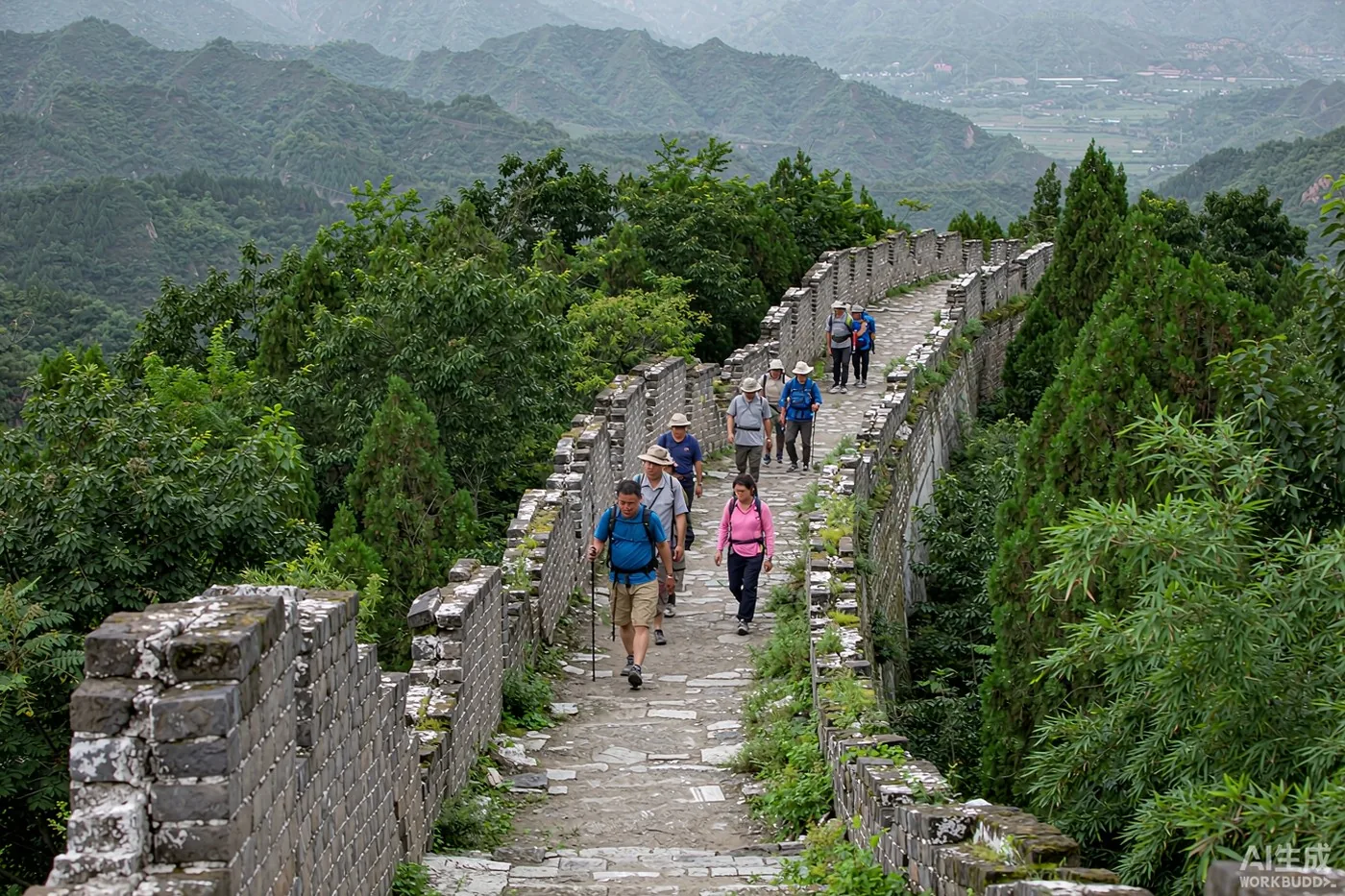
You can still walk a wall for hours. You just have to do it on a section that is open.
Open sections — Mutianyu, Jinshanling, Simatai at Gubei Water Town, Huanghuacheng, Juyongguan and Badaling are all ticketed and legal.
Best for walking — Jinshanling is the one walkers rate highest — the wall is well preserved, crowds are thinner than at Badaling, and you can walk a long chain of beacon towers. Mutianyu has better vegetation and a cable car plus toboggan if you want the descent to be fun.
Chasing the ruined look — Huanghuacheng gives you wall-in-water drama legally, and Jinshanling has unrestored stretches inside an open, ticketed site. Neither requires breaking the rule.
Full detail — Ticket prices, transport and which section suits which day are covered in our Great Wall guide.
The rules that keep a day hike boring, in the good sense
Beijing's mountains are not technically hard, but they are further from help than they look, and the rescues are almost always about preparation rather than terrain.
Shoes and light — Proper walking shoes with grip, and a headlamp even if you intend to be back by mid-afternoon. Running out of daylight is the most common way a routine walk becomes a rescue.
Water and food — At least two litres of water per person in summer, plus high-energy food. There is nowhere to buy anything along the canyon.
Layers — The mountains run roughly five to ten degrees cooler than the city. Carry a warm layer and a rain shell even on a clear morning.
Communication — Signal drops once you gain height. Go with at least one other person, and leave your route and expected return time with the hotel front desk. Emergency numbers are 110 police, 119 fire and rescue, 120 ambulance.
Thunderstorms — June to August brings frequent afternoon storms. Never camp on a ridge or on a wall — the 2024 Jiankou lightning strike hit people sleeping on the wall. Check the forecast before committing to an exposed route.
After rain — Avoid narrow canyons for a day or two after sustained rain; debris flows are the specific risk in gorges like Baihe.
Cold water — The river stays cold even in high summer. Wading in without warming up is a reliable way to cramp.
Turnaround time — Mountain valleys darken early, around 17:00 in winter. Set a turnaround at least two hours before sunset and stick to it.
If it goes wrong — Rescue in an unopened or closed area can leave you carrying the cost. That is a further reason to stay on legal ground.
Carry your passport — Mountain checkpoints and any overnight registration in a village both require it.
Getting out there without a car
Both trips are doable by public transport, but the timetable is the trip's real constraint.
Huanghuacheng by bus — From Dongzhimen, the 916 express to Huairou bus station, then the H21 or H35 to Huanghuacheng and a fifteen-minute walk. Roughly three hours each way, and the last return bus leaves early, around 16:00.
Huanghuacheng by shuttle — A tourist coach leaves Dongsi Shitiao metro station, exit C, at about 08:00 daily and drops you at the car park, about 200 m from the entrance. Return fare around RMB 80, children RMB 40, and a package covering coach, ticket and guide is around RMB 120 per adult.
Driving — Jingcheng expressway to Daqingguang to Huairou–Changping road, about 1.5 hours in clear conditions. After 08:00 at weekends the outbound Jingcheng is routinely jammed and can run past 2.5 hours. Parking is around RMB 20 a day, and P1 and P2 are usually full by 10:00, after which you park at P3 and take the shuttle.
Fuel — There are no filling stations in the mountain stretches. If driving, set off with enough fuel for the whole day.
The return leg is the risk — Whether you go by bus or hire a car, the hard part is getting back. Buses are infrequent and taxis are scarce in the villages — agree the return before you start walking.
Consider a club — Weekend hiking clubs run coach trips to Baihe and similar valleys for roughly RMB 88 including transport and a guide. For a first trip without a car this removes most of the logistics.
Related Beijing guides
If you found this useful, these cover the next question most visitors ask:
Stay legal — Jiankou and other unopened sections are prohibited, fined and genuinely dangerous. Do not climb them.
Pick one — Huanghuacheng for the wall-in-water and an easy half day; Baihe for a real walk of four to five hours.
Check the closing day and season — Huanghuacheng runs shorter hours in winter; last entry is commonly 16:30.
Start early — Buses take three hours each way and the last one leaves around 16:00. An 08:00 departure is the difference between a trip and a near miss.
Offline map — Download the track before leaving the city — signal is unreliable in the canyon.
Two litres, minimum — Per person in summer, plus food. There is nothing to buy out there.
Headlamp regardless — Even on a short walk. Darkness is the usual cause of a rescue call.
No ridges in storms — June to August afternoons. Never camp on a wall or an exposed ridge.
Passport on you — Checkpoints and village registration both need it.
Book the return ride — Agree it before you set off, not when you are tired at the far end.