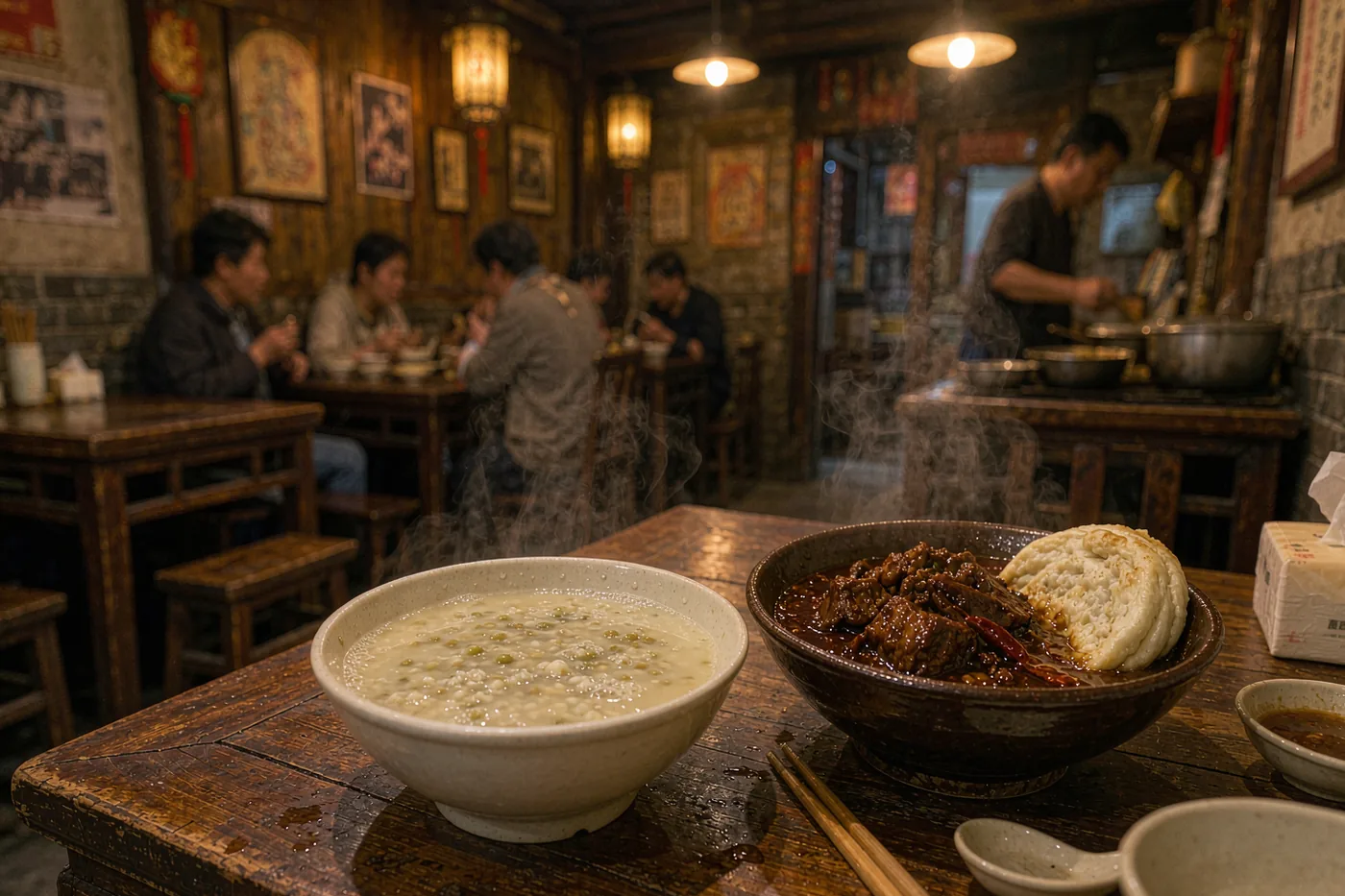
Explore Beijing / Douzhir, Luzhu and Chaogan: A Brave Eater's Guide to Old Beijing Snacks
Douzhir, Luzhu and Chaogan: A Brave Eater's Guide to Old Beijing Snacks
How to actually eat Beijing's hardest old-school snacks — douzhir, chaogan, luzhu and miancha — with the classic shops, prices, hours and first-timer tactics.
6 min read · KOULING's Beijing Travel Guide
Every cuisine has dishes locals eat weekly and visitors fear, and Beijing's list is unusually famous: douzhir (fermented mung-bean drink), chaogan (liver-and-intestine soup), luzhu huoshao (offal-and-bread stew) and miancha (sesame-topped millet paste). These are not museum pieces — they are what taxi drivers and market vendors eat at 6 a.m., a few yuan a bowl, in shops that have barely changed in decades. This guide explains what each dish actually is, names the classic shops serving them now, gives realistic prices and hours, and walks you through ordering and surviving your first bowl. It covers the dishes and the shops themselves: our breakfast guide already handles the full morning routine, and the Niujie guide covers the Muslim-quarter food street, so those angles are deliberately left out here.
Douzhir: the famous sour one
Douzhir (豆汁儿) is the liquid drained off when mung beans are processed into starch for glass noodles — fermented until it turns grey-green, sour, and faintly sulfurous. Locals drink it piping hot with a fixed entourage: a crispy fried dough ring called jiaoquan (焦圈), a dish of pickled shredded vegetables (辣咸菜丝), and chili oil if you want it. The taste is genuinely acidic, with a creamy, slightly cheese-like body; the smell is what defeats people. First-time descriptions run from sour yogurt gone wrong to old socks, while regulars call it refreshing. Price makes the experiment trivial: roughly ¥3–8 a bowl ⚠️ 待人工确认.
Where to try douzhir
Douzhir shops are morning places, bare-bones and family-run. Three names cover every kind of first-timer:
Yin San Douzhi 尹三豆汁 — Bare-bones, morning-only institution on Dongxiaoshi Jie, a short walk north of the Temple of Heaven's north gate; about 05:30–12:30 ⚠️ 待人工确认; bowls from about ¥3 ⚠️ 待人工确认; Metro Line 7 to Qiaowan ⚠️ 待人工确认.
Old Ciqikou Douzhi 老磁器口豆汁店 — Directly opposite the Temple of Heaven north gate on Tiantan Lu, open about 06:00–20:00 ⚠️ 待人工确认; the douzhir is milder and the menu wider, which makes it the friendlier first stop.
Huguosi Snacks 护国寺小吃 — A well-known snack chain where you can hedge: order douzhir beside wandouhuang and lüdagunr, and retreat to the sweet ones if the sour one wins.
Chaogan: liver, intestine and garlic
Chaogan (炒肝) is not fried and barely looks like a liver dish: pork liver slices and pork intestine simmered in a starch-thickened, soy-dark sauce heavy on garlic. Texture is the point — thick enough to cling, and tradition says no spoon: hold the bowl, rotate it, sip around the edge. Add a basket of pork-and-scallion steamed buns and you have the classic Gulou breakfast. The signature shop is Yao Ji (姚记炒肝) at 311 Gulou Dongdajie, steps from the Drum Tower, and the local saying goes 'for chaogan, turn the corner at Gulou' (要想吃炒肝,鼓楼一拐弯). A small bowl runs about ¥18 ⚠️ 待人工确认.
Yao Ji Chaogan 姚记炒肝 (Gulou) — 311 Gulou Dongdajie, about 06:00–22:30 ⚠️ 待人工确认; Metro Line 8 to Shichahai, exit A2 ⚠️ 待人工确认; small bowl about ¥18 ⚠️ 待人工确认; counter ordering, fast turnover.
Luzhu huoshao: the heavyweight
Luzhu huoshao (卤煮火烧) is the most substantial of the family: pork intestine, lung, fried tofu and wedges of huoshao (a dense wheat bread) simmered together in a pork-offal broth, then chopped, soaked and served in one big bowl. It began as an affordable stand-in for the Qing court's braised pork and has stayed a working-class staple ever since. The broth-soaked bread is the staple carbohydrate, which makes it a full meal — expect ¥25–50 a bowl ⚠️ 待人工确认. The best-known name today is Menkuang Hutong Centennial Luzhu (门框胡同百年卤煮), a small chain.
Menkuang Hutong Luzhu 门框胡同百年卤煮 — Qianmen branch at 57 Meishi Jie, two minutes south of Qianmen's main street; Xinjiekou branch at 2 Zhaodengyu Lu (Metro Line 4 to Xinjiekou, exit B) ⚠️ 待人工确认; about ¥45–50 per person ⚠️ 待人工确认.
The gentle side of the old canon
Nobody needs to prove anything: half the old-canon menu is genuinely crowd-pleasing, and pairing harsh with gentle is exactly how locals eat it.
Miancha 面茶 — Millet porridge under a lid of sesame paste and sesame salt; the local way is to drink it around the rim without a spoon so each mouthful gets both layers; about ¥8 ⚠️ 待人工确认.
Wandouhuang 豌豆黄 — Chilled cake of sweetened pea purée, silky and barely sweet — the safest bite on any old-Beijing menu.
Lüdagunr 驴打滚 — Glutinous rice rolls stuffed with red-bean paste and rolled in toasted soybean flour.
Zhaguanchang 炸灌肠 — Slices of mung-bean starch fried until crisp-edged, dipped in garlic vinegar.
Tanghuoshao 糖火烧 — Dense flatbread swirled with brown sugar and sesame paste; often the thing regulars actually order at douzhi shops.
One-stop sampler — Huguosi Snacks main store, 93 Huguosi Jie (Metro Line 4 to Ping'anli, exit B) ⚠️ 待人工确认, covers all of the above for around ¥30–35 a person ⚠️ 待人工确认.
Survival tactics for your first bowls
Go early — These are breakfast institutions. Yin San stops serving at 12:30, and the calmest, best-stocked hours are before 9 a.m.
Start small and shared — One small bowl of chaogan plus one douzhir for two people is plenty; old shops refill, split and pack without ceremony, so nothing is precious.
Order the pairing — Douzhir without jiaoquan and pickle is a harder game; the crunch and the salt are what balance the sourness.
Drink it hot — Douzhir is served scalding on purpose; let it cool and the sourness sharpens while the fat congeals.
Have a bail-out — If a dish truly defeats you, say yǒudiǎn chī bu guàn (有点吃不惯, not quite used to it) and switch to wandouhuang. Nobody minds, and the bill is tiny.
What the ground truth looks like
Counter service, no English — Menus are handwritten and ordering happens at the counter; point at the vats and trays, or show the pinyin and characters from this guide.
Payment is easy — QR payment is universal and these old shops generally still take cash ⚠️ 待人工确认 — the friendliest combination in the city for a half-set-up phone.
Prices move — All prices here are typical late-2026 ranges from visitor reports and map listings; expect a yuan here and there ⚠️ 待人工确认.
Seats and turnover — Shared wooden stools, fast turnover, and weekend-breakfast queues at Yao Ji and Yin San; solo diners rarely wait long.
Ordering without much Chinese
Shops like these mostly predate table-QR ordering: you queue at the counter, point, and pay on the spot. The words that do the work are douzhir (豆汁儿), jiaoquan (焦圈), chaogan (炒肝), luzhu (卤煮) and miancha (面茶) — say the pinyin or show the characters and staff take it from there. If a place does hand you a QR menu, screenshot-and-translate plus the techniques in our reading-Chinese-menus guide cover it; that guide handles the full mechanics, so they are not repeated here.