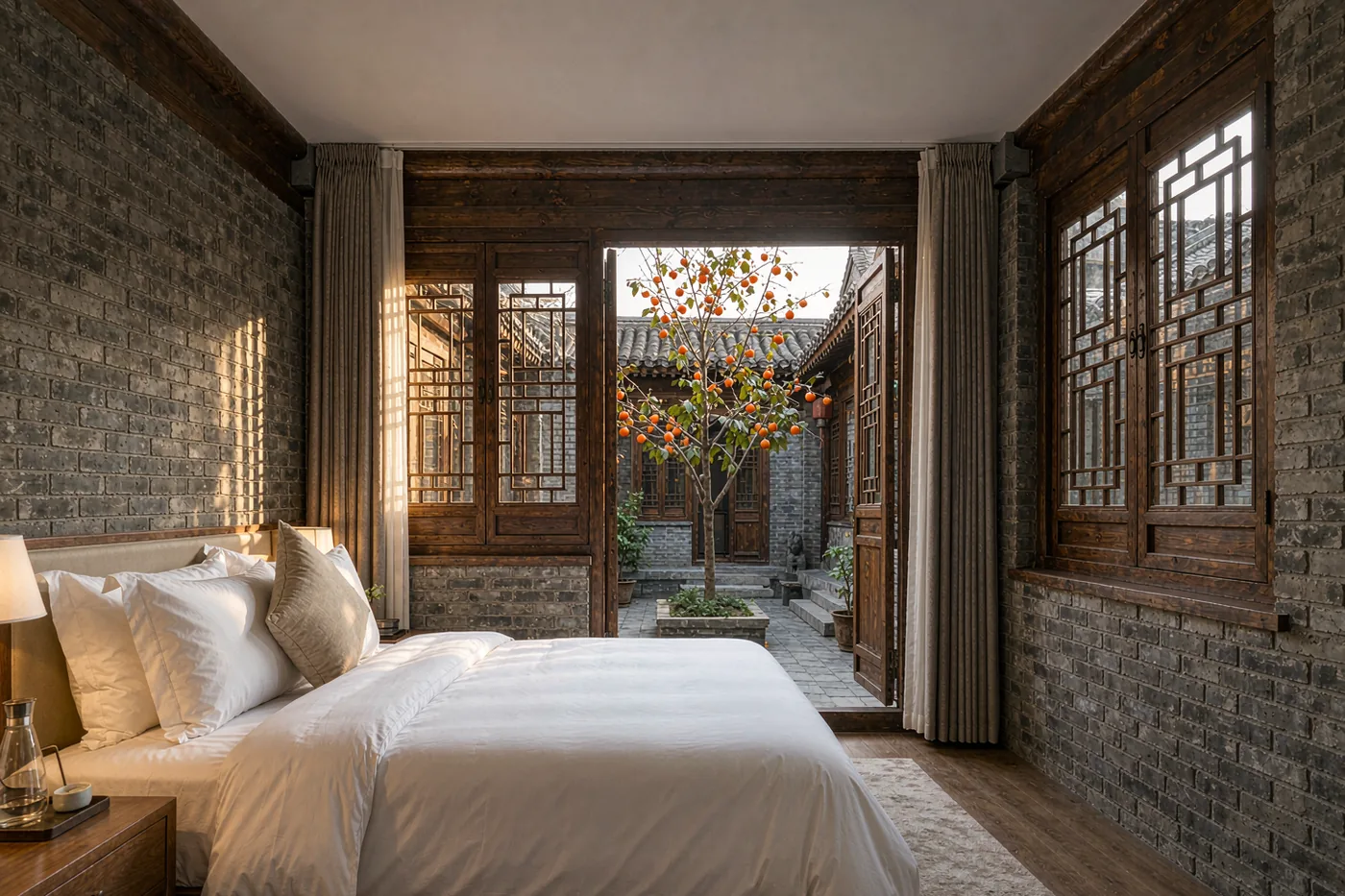
What it is really like to sleep in a converted siheyuan: realistic prices, the best hutong neighborhoods, heating and luggage realities, and the checks to make before you pay.
Inside Beijing's second ring road, the hutong districts hide a category of hotel no tower can copy: siheyuan — traditional courtyard houses — converted into small hotels where guest rooms open onto a stone-paved yard with persimmon trees, pigeons overhead and laundry drying on bamboo poles. Staying in one is the fastest way to feel the city's old rhythm, and prices now start lower than most visitors expect. But courtyard hotels are genuinely different to book: rooms are small, alleys are narrow, heating varies wildly between conversions, and a few small guesthouses still cannot register foreign passports. This guide covers what you are actually booking, realistic prices, the best neighborhoods, and the checks that separate a magical stay from a disappointing one. It is about the hotels themselves: our where-to-stay guide compares the city's districts in general, and the hutong walking guide covers the lanes as a daytime activity, so those angles are left out here.
A siheyuan (四合院) is a walled compound arranged around one or more open courtyards: main rooms face south, side wings east and west, with carved doorways and a screen wall just inside the gate. A courtyard hotel is one of these compounds renovated for guests. Expect one- or two-storey buildings — never lifts — a small room count (ten to thirty is typical), a communal yard, and often a teahouse corner or rooftop terrace. The quality range is enormous. At the modest end you get simple rooms in a lived-in alley house; at the high end, conversions hide underfloor heating, silent fresh-air systems, triple glazing and stone bathrooms behind the antique facade. Two things almost always stay true: the buildings are old, so layouts are irregular, and everything is human-scaled — you will know the front-desk staff by name on day two.
Courtyard hotels span a wider price range than chain hotels. Simple conversions rent rooms for roughly ¥300–500 a night; comfortable mid-range courtyard rooms with en-suite bathrooms cluster around ¥600–1,000; designer compounds with suites, bathtubs and full service run about ¥1,500–2,500, and courtyard suites at the top properties can exceed ¥3,000 [verify]. Weekends and Chinese holidays push every band upward, and the best-value yards sell out first — book at least two weeks ahead for the October and May holiday seasons. One nuance to set expectations: room size does not scale with price the way it does in towers. A ¥900 room may be around 20 square meters facing the courtyard, while a chain hotel at the same price gives you 30 square meters plus a gym. What you pay extra for is the yard, the neighborhood and the quiet.
Courtyard hotels concentrate in a handful of old-city districts. The Nanluoguxiang and Drum Tower area in Dongcheng has the deepest selection, steps from Nanluoguxiang station on Lines 6 and 8. Guozijian, Wudaoying and the Yonghegong area in the northeast are calmer and café-lined, walkable to the Lama Temple, with Line 2 or Line 5 service nearby. Shichahai and Houhai put you beside the lakes, with Shichahai station on Line 8. Qianmen and Dashilan in Xicheng offer renovated alleys within walking distance of Tiananmen, served by Lines 2 and 8 — often the best pick for a first visit built around the landmarks. Dongsi, on Lines 5 and 6, is the quiet local-favorite option. One trade-off applies everywhere: the old city sits far from the airports, with taxi rides of roughly 45–70 minutes to Capital and 60–80 minutes to Daxing [verify], but most central sights end up within walking distance or one subway hop.
Every courtyard stay begins with a walk down a hutong, and it pays to plan that last stretch. Taxis and ride-hailing cars can stop only at the mouth of most alleys, so expect to walk 100–500 meters with your bags; some lanes are too narrow for two people to pass each other with suitcases. Three tactics make arrival painless. First, save the hotel's Chinese address and phone number — drivers navigate hutong addresses far more reliably from the Chinese characters, and many hotels send a pinned map location after booking. Second, ask the hotel to meet you at the drop-off point; staff with luggage carts are common at established properties and worth requesting. Third, travel light or ship the big bag ahead — the same courier networks that deliver rental gear to hotels can forward a suitcase from the airport. Leave 15 extra minutes: GPS accuracy inside hutongs is famously approximate.
Every property in China that hosts foreign guests must register your passport with the local police — a legal requirement under Article 39 of the Exit and Entry Administration Law, and it applies to courtyard hotels exactly as it does to chains. At check-in, reception scans your passport and visa and hands you a registration form of temporary residence; keep it, since visa extensions and some police or ticketing matters may ask for it. The landscape has recently loosened: a 2025 seven-ministry notice told booking platforms and local authorities to stop using licensing thresholds to block accommodations from hosting overseas guests, so many small courtyard hotels that once refused foreign passports now take them [verify]. Capacity still varies by property, so confirm foreign-guest registration before paying a non-refundable deposit. If you ever end up in a homestay that genuinely cannot register you, you must register in person at the district police station within 24 hours of arrival; Beijing also runs an online self-registration channel for such stays.
Pick a courtyard hotel if you are staying three nights or more, want the hutong neighborhoods as part of the trip rather than a detour, or are returning to Beijing after the headline sights. Pick a mainstream tower instead if this is a one- or two-night first visit on a tight schedule, you need a gym and a big desk, or you are traveling in deep winter and cannot tolerate any heating lottery. Families should know the math changes: connecting standard rooms barely exist in courtyards, so family rooms and suites sell early — the good ones are gone a month out in peak season [verify]. And if you fall for the format, remember the winter caveat cuts both ways: a courtyard room with working underfloor heating and snow on the grey tiles is one of Beijing's great hotel experiences — but only if the heating was installed properly.