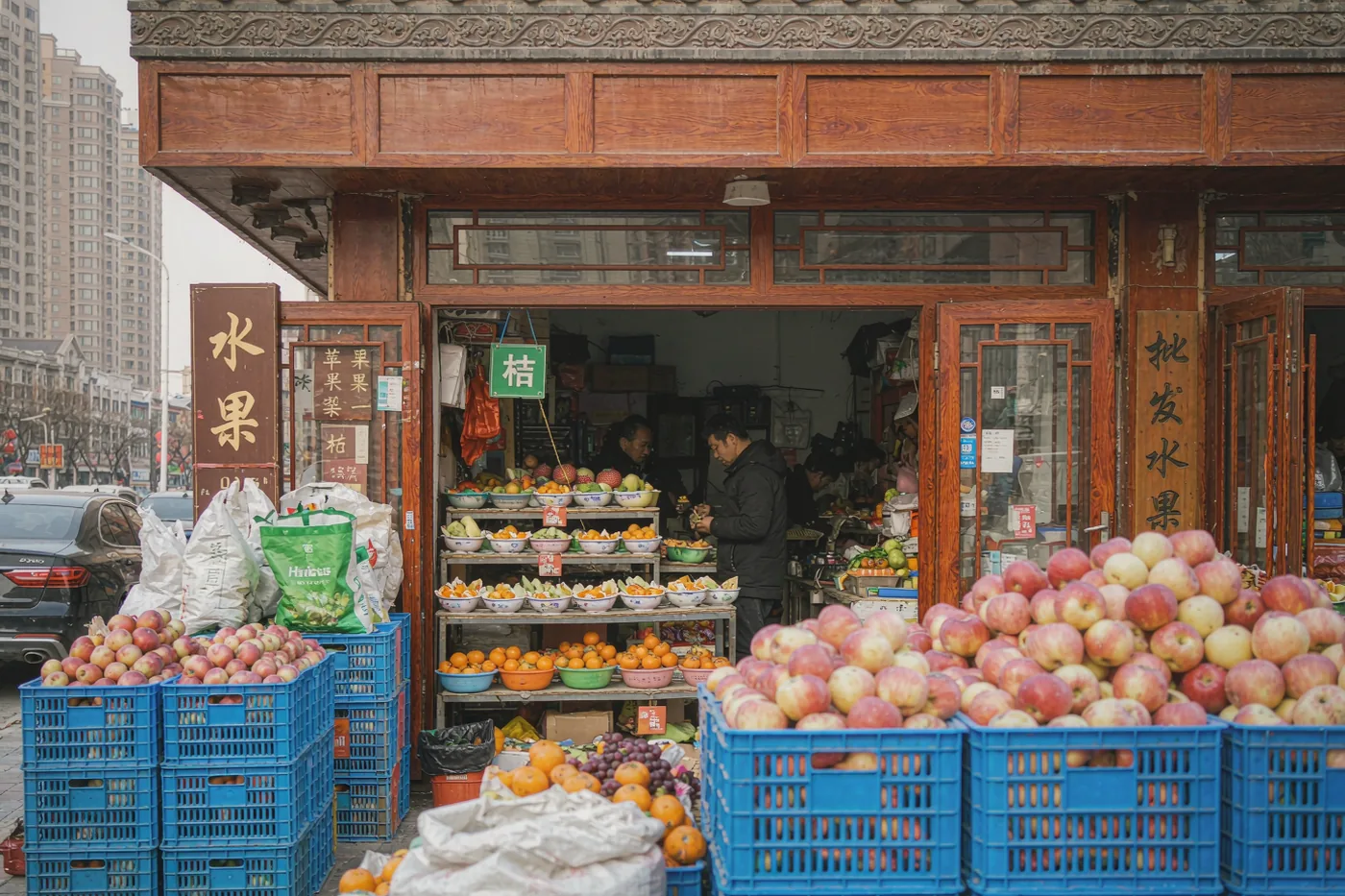
Street fruit shops are one of Beijing's best daily rituals: how per-jin pricing works, when cut fruit is safe, what is in season each month, and what things actually cost right now.
Beijing runs on fruit. From November to March, sugar tangerines pile up on street corners; summer is watermelon cut open on the spot, autumn is persimmons and roasted chestnuts. Locals buy small amounts daily — a couple of apples on the way home, half a jin of grapes for the evening — and the street fruit shops that make this possible are everywhere, cheap and open late. This guide covers how to actually use them: what the price signs mean, how weighing works, whether cut fruit is worth it, what gift baskets involve, and what things cost right now.
You will meet five very different fruit venues. The neighborhood fruit shop is the workhorse: a small storefront stacked with crates, run by one or two people, open from morning until around 21:00–22:00. Fruit stalls appear on sidewalks and near markets, often cheapest but more hit-and-miss. Chains like Guoduomei (果多美, part of the Pagoda group, 百果园, with coverage across nearly a hundred Beijing communities) trade a little price for consistency: standardized quality and app membership prices. Supermarkets such as Wumart (物美) and Freshippo (盒马) run weekly specials and let you pick piece by piece. Wet markets also sell fruit cheaply, but they deserve their own guide — see our fresh food markets article.
Almost all fruit in shops and stalls is sold by the jin (斤), which is 500 grams — not the kilogram you may expect. A sign reading 砂糖橘 4.99 means 4.99 yuan per 500 g, roughly 10 yuan per kilogram. Supermarket shelf labels are the exception: the small print may say per 500 g (每500g) or per kilogram (每千克), so check the unit before comparing. At a shop the flow is standard: you point at what you want, the vendor weighs it on an electronic scale, and the scale prints a sticky barcode label with the weight, unit price and total. Take the label to the counter or scan the QR code printed on it.
Fruit shops are built for self-selection. Grab a basket or plastic bag and pick piece by piece — locals routinely set aside a bruised apple and take the next one, and nobody minds. If you are unsure how something tastes, ask "甜不甜?" (Is it sweet?) or "能尝一个吗?" (Can I try one?); vendors of tangerines, grapes and cherry tomatoes usually hand over a sample. Hand your bag over for weighing, take the printed sticker, pay by scanning its QR code with Alipay or WeChat Pay (both now work with international cards), or pay cash. Hard bargaining is not part of fruit-shop culture; at open-air stalls there is sometimes a little flexibility on multi-kilo buys, but expect fixed prices in shops.
Alongside whole fruit, most shops and many stalls sell 果切 (guoqie) — peeled, cut fruit packed into transparent boxes: watermelon cubes, pineapple spears, mixed melon, sometimes durian. Pricing is usually by the box (roughly 10–30 yuan depending on the fruit; durian runs higher) or by weight. Cut fruit is genuinely useful in a hotel room with no knife or board, but it is also the fastest-spoiling product on sale: buy where turnover is high, choose boxes kept in a fridge rather than sitting out on a tray, and eat it the same day. Anything that smells fermented or looks wet and collapsed goes back down.
Two gift formats exist. The ready-made fruit basket (果篮) — cellophane-wrapped, stacked with apples, oranges and kiwis — is sold near hospitals and flower shops for roughly 100–300 yuan, but cellophane hides quality and hospital-gift baskets have a reputation for mediocre fruit. The better move: pick your own fruit and ask the shop to assemble a basket, or skip the basket entirely. Gift boxes are a different animal: Beijing's famous regional fruits come in branded boxes that locals genuinely use when visiting friends — a Pinggu peach gift box runs 60–150 yuan for eight pieces, a Daxing watermelon gift box 50–90 yuan per melon, Changping strawberries 20–40 yuan per jin boxed.
Fruit retailing in Beijing follows the seasons harder than in most cities, because local specialty fruit — much of it carrying protected geographical-indication status — floods the city at its moment and then vanishes.
Prices swing with supply, so treat these numbers as a calibration tool rather than a tariff sheet. The snapshot reflects Beijing retail in November 2026 plus published daily averages from the Yuegezhuang wholesale market; supermarket specials can undercut all of it.
Every major app delivers fruit: Meituan and Ele.me dispatch from the fruit shop nearest to you within 30–60 minutes; Freshippo and Wumart deliver their own stock; Meituan Maicai and Duoduo Maicai ship cheap case-lot fruit next day. The convenience is real but so is the markup — once delivery fees are counted, street-shop prices usually win. Our grocery shopping guide covers the delivery ecosystem in depth.