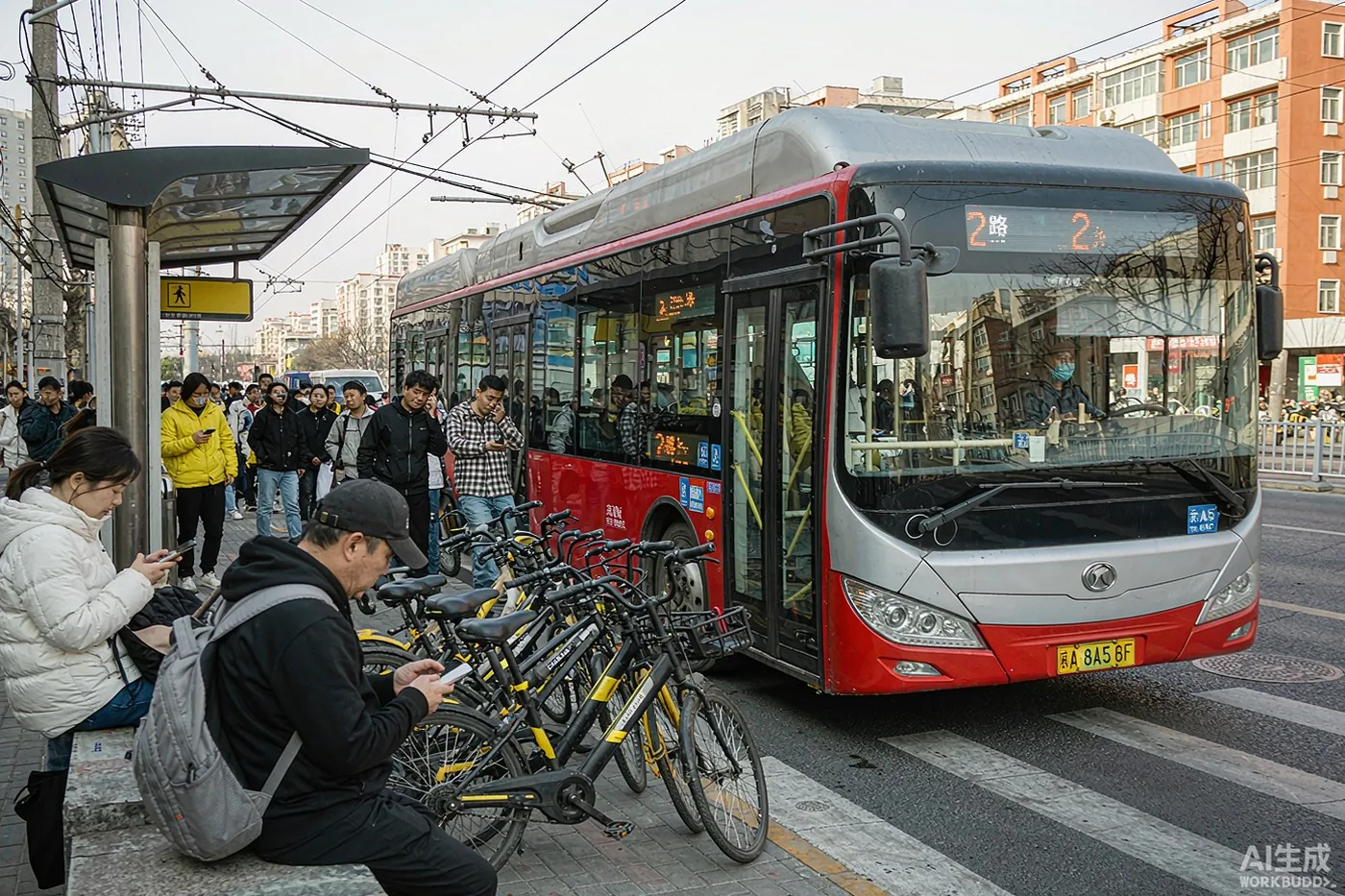
Beijing's buses are cheap, dense and reach corners the subway skips — once you know how to read the stop sign and pay. A practical walkthrough for foreign visitors.
8 min read · KOULING's Beijing Travel Guide
Most visitors never board a Beijing bus. They ride the metro, they ride Didi, and they miss roughly 1,000 surface routes that cost the price of a bottle of water. That is a shame, because the bus solves exactly the trip the subway handles badly: the last kilometre, the crosstown hop that needs two transfers underground, and the ride where you would rather see the street than a tunnel wall. You do not need to read Chinese to use it. You need about fifteen minutes of setup and a bit of courage at the kerb.
Why bother with the bus
The metro is faster across town and far easier to navigate blind. The bus wins in four specific situations, and those are worth knowing before you decide it is not for you.
Short hops that the metro overshoots — Two or three stops across a neighbourhood: a bus is one ride, the metro is a walk down, a wait, a walk back up.
Crosstown trips with no good rail link — Beijing's radial metro often forces you into the centre and back out. Buses run the diagonals directly.
Bad weather and heavy bags — A bus stop is usually closer to your building than a station entrance, and you skip the stairs and the security queue.
When you want to see the city — The front seat upstairs or by the window is a cheap, slow tour of a street you would otherwise never walk.
Fares: two systems, one price range
Beijing buses moved to distance-based fares in 2014. The standard city bus starts at CNY 2 for roughly the first 10 km and adds CNY 1 for each additional 5 km or so; in practice most central journeys land between CNY 2 and CNY 5, and only a long cross-city ride reaches CNY 8–10. Some short community and airport-area shuttles use a flat fare instead. Treat the figures as a range rather than a promise — the exact step-up rule has been adjusted over the years — and just know that a bus ride is almost always cheaper than a metro ride.
Flat-fare lines — Pay once when you board, usually CNY 2–3. The fare is posted by the door.
Distance-based lines — Pay or scan when you board, and again when you get off. Miss the second tap and you are charged to the end of the line.
How to tell which — A sign near the front door or a line on the onboard screen states the fare model and the maximum fare.
Paying: what actually works for a foreign visitor
This is the part that stops people. Cash works but is the weakest option; a QR code is the one to set up on your first evening, before you need it.
Alipay ride code — Open Alipay, switch the city to Beijing, and open the transit ride-code mini-program. Show the QR to the scanner by the driver. This is the single most useful setup step of your trip.
WeChat Pay ride code — Same idea, different app. Both need a bound international card, which takes a few minutes — do it on hotel Wi-Fi, not on the kerb.
Cash — Accepted, but drivers usually cannot make change and prefer exact coins or a clean CNY 5 note. On a few longer, conductor-staffed lines a 售票员 sells you a paper ticket and can change a note.
Physical transport card — A Yikatong (一卡通) card bought at a metro station works on buses too and saves the phone ritual, at the cost of a deposit.
Foreign contactless cards — Do not count on tapping a Visa or Mastercard on a bus the way you can at metro gates. Carry a working QR code or cash instead.
Reading a bus stop
A Beijing stop is a pole or a shelter with a plastic board listing every route that calls there. It is all Chinese, and it is more readable than it looks once you know where to look.
The direction line — Each route is listed with its two terminal points. Match the terminal you are heading toward, not the route number alone — the same bus number runs both ways on opposite sides of the street.
First and last bus — 首班 means first bus (often around 05:00–06:00), 末班 means last bus (often 21:00–23:00). If you are out late, photograph this line.
The stop name — Newer signs include pinyin under the characters. Screenshot the characters anyway — you will need them to ask for help or to type into a map app.
Stops are not always where the app says — Opposite-direction stops are frequently several hundred metres apart, and two stops can share a name. Walk to the side of the road matching your direction.
Decoding route numbers
The prefix before or above a number tells you what kind of service it is. This is the cheapest Chinese lesson you will get in Beijing.
Plain numbers — Standard city buses, by far the majority. Higher numbers are usually newer, more suburban routes.
夜 (yè, night) — Night buses. They follow the main corridors after the metro closes and are the cheapest way home after midnight.
快速公交 / BRT — Bus rapid transit on dedicated lanes along the big avenues. Genuinely fast, because they skip the traffic the rest of the road sits in.
专 (zhuān, special) and 通勤 (tōngqín, commuter) — Short community feeders and peak-hour express runs. Mostly useful if you are staying outside the Third Ring.
观光 (guānguāng) and 旅游 (lǚyóu) — Sightseeing and tourist services — see the caveat in the next section.
Boarding, riding, getting off
The mechanics are simple, and the mistakes are all recoverable.
Board at the front — Front door in, middle or rear doors out. Pay or scan as you step up, then move down the aisle so the next person can board.
Signal the stop — Stops are announced in Chinese only, and not every bus stops unless someone asks. Watch your map app for the approaching stop and move to a door early.
Scan again on the way out — On distance-based lines, tap or scan at the rear reader before stepping off, or you pay the fare to the terminus.
Priority seats — The seats nearest the door are reserved for elderly, pregnant and disabled passengers. Giving one up is expected, not optional.
Keep your phone pocketed at the door — Crowded buses are the classic pickpocket setting. Phone in a front pocket, bag in front of you.
The bus services worth knowing as a visitor
You will not memorise routes, and you should not try — let a map app pick them. But four categories of bus come up again and again in a visitor's week.
Airport coaches (机场巴士) — Official coaches link both airports with city hubs such as railway stations and major hotel districts. Expect roughly CNY 25–40 for a seat, buy at the desk inside the arrivals hall, and check the destination list before queuing — lines are numbered, not obvious, and fares change — confirm at the arrivals-hall desk before you pay.
BRT on the main avenues — The dedicated-lane routes along the central north–south axis and the big east–west corridors move far faster than a taxi in rush hour.
Night buses (夜) — When the metro shuts a little after 23:00, the 夜 network is how locals get home. Fares stay at city-bus levels; frequency drops to every 20–40 minutes.
Sightseeing and tourist lines — Hop-on hop-off and day-tour buses exist, mostly departing from central hubs, but they are seasonal and prices vary widely. Buy at the staffed kiosk, never from someone who approaches you on the street.
Practical tips that save you a bad hour
Set up your ride code the night before — Standing at the front door of a bus with a queue behind you is the worst place to bind a credit card.
Avoid 07:30–09:30 and 17:30–19:30 — Buses sit in the same traffic as everything else outside their dedicated lanes. Double your time budget, or take the metro.
Use Apple Maps or Amap, not Google Maps — Google's transit data for Beijing is unreliable and its map is offset. Apple Maps works in China; Amap (高德地图) is what locals use and has real-time bus arrival.
Count the stops, not the minutes — Traffic makes timings meaningless, but distance is fixed. If your app says six stops, you are six stops away whatever the clock says.
Keep small notes and coins — A CNY 5 note and a few coins turn a cash emergency into a non-event.
Photograph the stop sign you boarded at — Finding the return stop is much easier when you have the characters and the terminal name saved.
When to skip the bus
Do not be a purist. Take the metro if you are crossing more than about 8 km, if you are running late, or if your route follows a metro line anyway — the subway simply does that trip faster. Take a taxi or Didi after 23:00 if you are tired or in an unfamiliar part of town, and take one in July and August afternoons when standing on a hot pavement stops being charming. The bus is a tool for the middle distance, not a lifestyle.