A practical guide to baijiu in Beijing: the four aroma types, what bottles really cost, how to get through the toasts, how to decline a drink without offending anyone, and one medical warning you should know before you touch it.
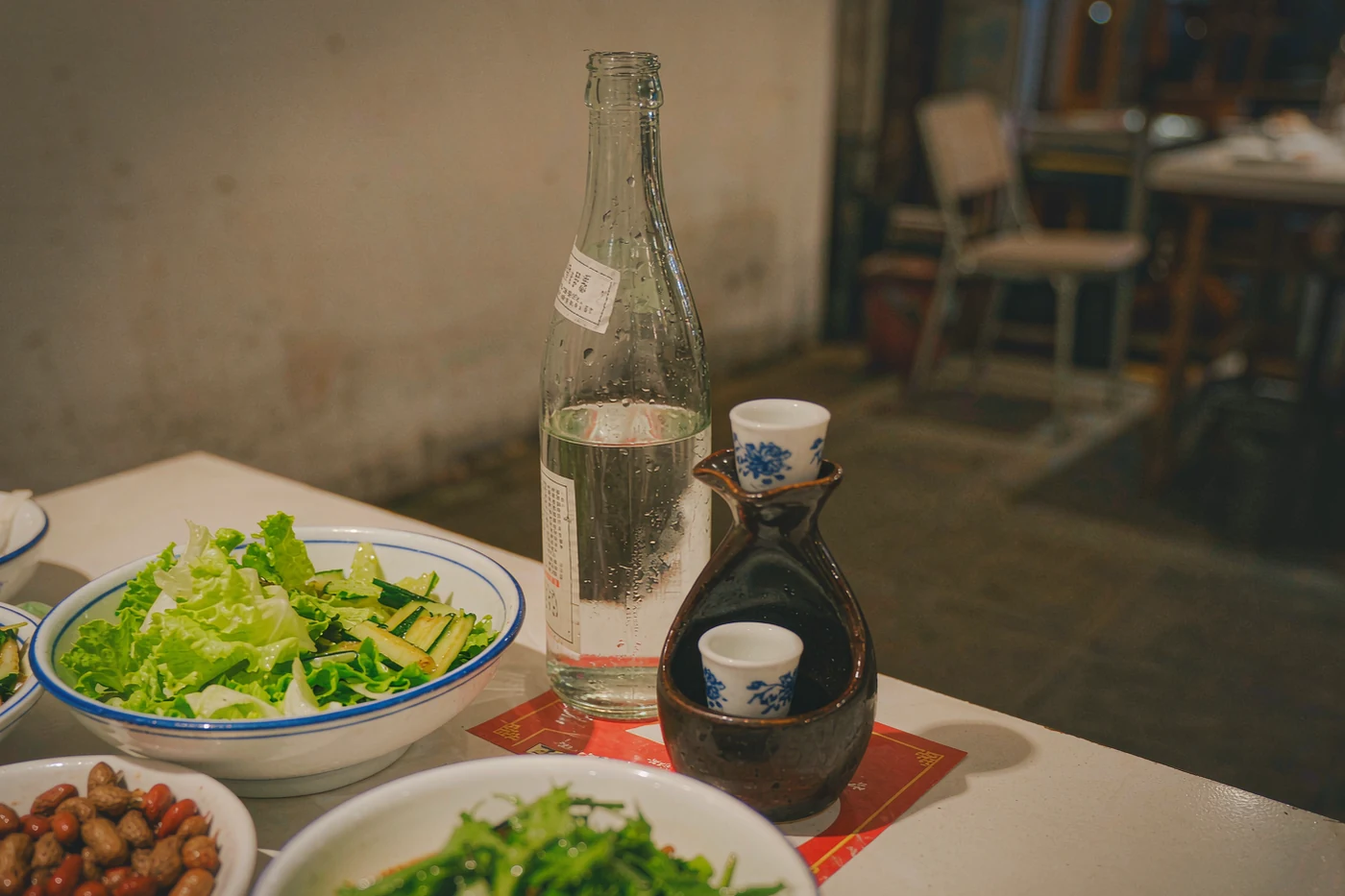
Somewhere around the second course, someone at your table in Beijing will pick up a small ceramic flask, fill a glass the size of a thimble with a clear liquid, raise it and say ganbei (干杯, literally “dry the glass”). That is baijiu (白酒) — China's national spirit, the best-selling liquor in the world by volume, and the single thing on a Chinese dinner table that most reliably catches visitors out. It is not rice wine, it is not vodka, and at 40–60% ABV it has more in common with cask-strength whisky than with anything most travellers have ever poured for themselves. This guide covers what baijiu actually is, the four aroma types and which one to try first, what bottles genuinely cost in Beijing, how to get through the toasting, how to say no without offending anyone, and one medical interaction that can put you in hospital.
Baijiu is a distilled grain spirit, most often made from sorghum (高粱), sometimes with wheat, rice or corn. What separates it from whisky or vodka is the starter: instead of cultured yeast, fermentation uses qu (曲), a pressed cake of wild moulds and yeasts that converts starch into sugar and ferments it in the same step — a solid-state process, not a liquid mash. The spirit is then distilled and aged in clay jars or stainless steel rather than oak, which is why it is clear and why it never tastes of wood. The result is aromatic in a way Western spirits are not: fruity, floral, and in some styles distinctly savoury and soy-like. It is also strong. Most bottles sit between 40% and 60% ABV, and the prestige bottles cluster around 52–53%. Baijiu is not 黄酒 huangjiu (the brown, low-alcohol fermented “yellow wine”), not 米酒 mijiu (sweet rice wine), and definitely not 料酒 liaojiu (salted cooking wine). If a menu says “white spirit” or “Chinese liquor”, it means baijiu.
Baijiu is classified by aroma category, and knowing the four main ones is the fastest way to order something you might actually like. 浓香 nóngxiāng (“strong aroma”) is the biggest seller — sweet, fruity, almost pineapple-like, led by 五粮液 Wuliangye and 泸州老窖 Luzhou Laojiao. 酱香 jiàngxiāng (“sauce aroma”) is the most complex and most divisive: savoury, soy sauce, fermented bean and funk, with 茅台 Moutai as the benchmark. People who love it really love it; first-timers often describe it, unkindly but not unfairly, as blue cheese or soy sauce. 清香 qīngxiāng (“light aroma”) is the cleanest and the best place to start — floral, crisp, faintly apple-like, with 汾酒 Fenjiu and Beijing's own 二锅头 erguotou. 米香 mǐxiāng (“rice aroma”) is the mildest, rice-sweet, and rarely seen on Beijing shelves; 桂林三花 Guilin Sanhua is the reference bottle. If you only try one, make it a 清香.
Treat baijiu like a spirit, not like a beer. At 52% ABV, a 30 ml measure holds roughly 12 g of pure alcohol, and China's own dietary guidelines put an adult's daily ceiling at about 15 g — so one brim-full thimble-glass is already close to it. [verify] The traditional glasses are deliberately tiny, around 10–20 ml, and are filled only half to two-thirds; the point is many small sips across a long meal, not shots. 干杯 gānbēi literally means “dry the glass” and in practice means finishing what is in front of you in one go — but leaving a little is entirely normal and nobody is counting. Food is part of the method rather than a side dish: baijiu is drunk with a meal, and a banquet keeps the plates arriving for exactly that reason.
Prices move, so read these as brackets rather than quotes. At the bottom sits Beijing's everyday baijiu — 红星 Hongxing or 牛栏山 Niulanshan 二锅头 — roughly ¥20–60 for 500 ml, which is what a large part of the city actually drinks: honest, rough-edged, and perfectly fine in a tiny glass with food. [verify] Mid-shelf national brands such as 剑南春 Jiannanchun, 泸州老窖 and 水井坊 Shuijingfang typically run into the several-hundred-yuan range for 500 ml. [verify] At the top, a bottle of 53% 飞天茅台 Kweichow Moutai is a luxury good whose street price swings with the market — expect four figures, and expect a shop to ask more than any official retail figure. [verify] In restaurants, the same bottle is marked up hard, often 1.5–3× the shop price, and some places add an 开瓶费 corkage if you bring your own. [verify] The practical conclusion: buy the cheap bottle to learn on, and drink the expensive one when somebody else is paying.
Buy from a large supermarket, from the brand's own flagship store on 京东 JD.com or 天猫 Tmall, or from a licensed 烟酒店 tobacco-and-liquor shop on a main street. What you avoid is a small shop offering a premium bottle at a suspicious discount, anyone selling “duty-free” or “internal” Moutai out of a car, and bottles with a missing or damaged anti-counterfeit label (防伪标签). Most major brands print a scratch-off code or a QR traceability code you can check on the brand's own site before you open the bottle, and it takes about thirty seconds. Keep the receipt (小票) until the bottle is open — without one, a return is a negotiation you will lose. Airport duty-free is the safest channel of all if the bottle is going home with you.
You need very little, and the rules are forgiving towards foreign guests. Pour for other people before you pour for yourself, and hold the bottle in both hands when pouring for someone clearly senior. If the person toasting you stands up, stand up. When glasses meet, holding your glass rim slightly lower than the other person's is a small, visible sign of respect that people genuinely notice. At a business or family banquet the first toast usually comes from the host or the most senior person and works outward from there. 干杯 means finish it; 随意 suíyì means “as you like”, and if someone says 随意 to you, take the gift. Do not turn your glass upside down to show you are finished — leave it upright and simply stop refilling it. And do not pour yourself the last of a bottle without offering it round the table first.
Refusing is possible, and there is a script for it. The accepted excuses are specific and medical: 我吃了头孢 (“I'm on antibiotics” — see the warning below), 我酒精过敏 (“I'm allergic to alcohol”), 我今天开车 (“I'm driving today”), or 医生不让我喝 (“my doctor told me not to”). 我不会喝酒 (“I can't drink”) also works. What matters is saying it once, early and consistently, rather than for the first time after three glasses. The graceful move at the table is 以茶代酒 — raise a full glass of tea, herbal tea or soda and toast with it; a full glass of anything that you raise and actually drink is socially sufficient. What does not work is leaving your glass untouched all evening, or quietly tipping baijiu into your water glass. Both are noticed, and both read as cold rather than polite.
You do not have to wait for an invitation. Beijing's cocktail bars have taken baijiu seriously for several years now, and bars around 三里屯 Sanlitun and 前门 Qianmen build drinks around its savoury, fruity edge — baijiu with oolong, with osmanthus (桂花), with ginger or with citrus, which is a considerably gentler introduction than a thimble of 52% neat. Ask for a 白酒鸡尾酒 (baijiu cocktail) or simply ask whether they have anything made with baijiu; if a bar keeps baijiu at all, the bartender will be pleased you asked. Some places run tasting flights, which are the cheapest way to put 酱香 next to 清香 in one sitting. A guided tasting or a food tour is worth considering precisely because somebody else chooses the bottles. [verify]
Two different rulebooks apply. Airlines: baijiu at 40–60% ABV falls in the 24%–70% bracket, which is generally permitted in checked luggage up to a per-person limit of roughly 5 litres and is banned from carry-on except as a sealed duty-free purchase — but confirm with your airline before you fly. [verify] Customs: the country you are flying into sets its own duty-free alcohol allowance, commonly around 1 litre of spirits. [verify] Buying at 机场免税店 airport duty-free solves most of it in one move — the bottle comes in a sealed tamper-evident bag, it is priced without some domestic taxes, and it settles the question of whether the bottle is genuine.