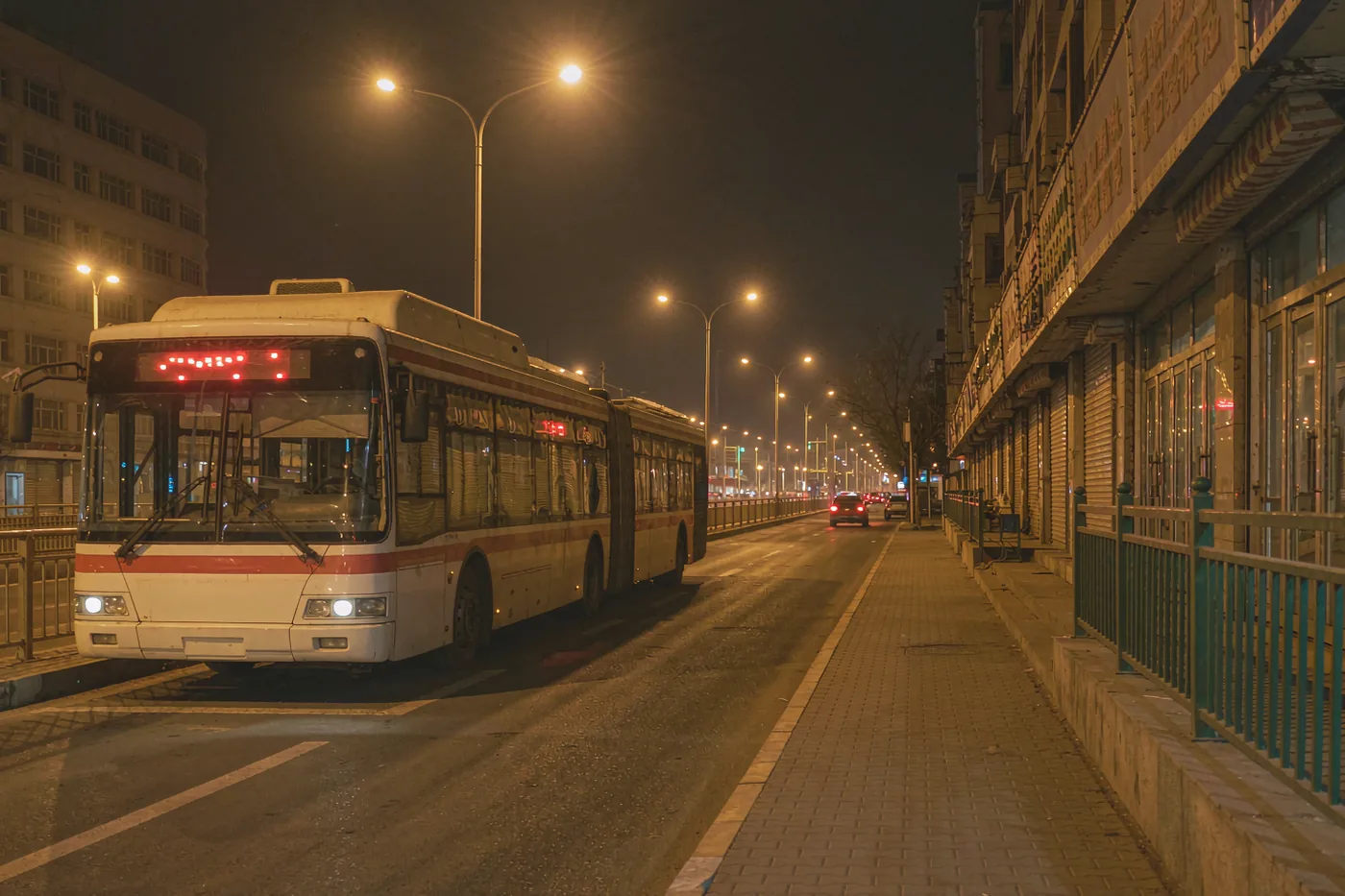
Beijing's metro shuts down around 11 p.m., but the city doesn't. Here's how night buses, taxis and ride-hailing work after midnight — and what everything costs.
Beijing's subway is superb, but it is not a 24-hour system. Most lines stop running between roughly 10:30 p.m. and 11:30 p.m., with last trains varying by station and direction [verify before travel]. If you're out late at a hotpot dinner, a Sanlitun bar or the airport, you'll need a plan. The good news: the city keeps moving all night, and your options range from a US$0.40 night bus to a US$10–20 taxi ride.
Last train times differ by line, direction and even individual station, and they change when new schedules roll out. As a rule of thumb, assume the last full through-service leaves central stations around 11 p.m. to 11:30 p.m. [verify before travel]. Station staff can tell you the exact last-train time for your destination, and the official Beijing Subway app or DiDi's metro planner show it in English [verify before travel]. Don't cut it close: if you miss your last transfer, the trip you planned becomes a much pricier ride home.
Beijing runs a network of night bus routes (routes numbered in the Yeban/night series, typically 6-digit numbers beginning with 'Y' or in the 200–299 range depending on current numbering) that operate after midnight [verify before travel]. Fares are inexpensive — a few yuan, under US$1 [verify before travel] — and you pay the same way as daytime buses, via cash, transport card or a mobile QR code. The catch: frequencies can be 30–60 minutes between buses, routes are limited compared with the daytime network, and real-time English information is patchy. If you're near a major interchange or Chang'an Avenue, your odds of a convenient night bus are much better. For first-time visitors without Chinese, a night bus is doable but requires checking route maps in advance; a taxi or Didi is often worth the extra few dollars for the simplicity.
This is how most late-night visitors get home. Beijing's licensed taxis add a low-speed/night-time component to the meter after roughly 11 p.m., so a fare that costs ¥30 (about US$4) in the day may come to a bit more at night [verify before travel]. On Didi (China's Uber equivalent), demand pricing kicks in after the metro closes — expect surge multipliers around midnight to 1 a.m. on weekends, especially in nightlife zones like Sanlitun, Gulou and Wudaokou. A ¥40 (US$6) daytime ride can become ¥60–90 (US$9–13) at peak surge [verify before travel]. Practical tips: set your pickup point carefully (pin to a landmark or hotel entrance, not a vague roadside spot), have your destination written in Chinese characters, and compare the Didi estimate against a street taxi if a queue is right there. Didi's international version accepts foreign credit cards, which saves you from needing a Chinese payment app [verify before travel].
This is the scenario that catches most first-timers: you land at 1 a.m., the metro and airport express trains have stopped, and you need to get to your hotel. Your realistic options are taxi, Didi, or a pre-booked hotel pickup [verify before travel]. Airport shuttle coaches run limited late-night routes on some corridors [verify before travel], but with luggage and jet lag, a direct ride is usually worth it. Agree on the meter for taxis (or use the official taxi rank, never touts inside the terminal). If you land very late, choosing a hotel with late-night transfer support or one near the airport for that first night removes all the stress.
Bar street and the Taikoo Li malls keep buzzing well past the last metro. When the bars close around 1–2 a.m., the taxi queue on the main road gets long and Didi surge peaks — either accept the surcharge, walk 10 minutes away from the nightlife core before booking, or wait it out at a late-night noodle shop.
The lakeside bars of Houhai and the hutong lanes around Gulou are a classic late night out. The streets are quiet and pleasant to walk even at midnight, but the nearest metro will be closed by the time you leave — most people here take a Didi back to their hotel. Pickup points in the hutongs can confuse drivers, so pin to Gulou East Street or a landmark gate.