Explore Beijing / Step-Free Beijing: A Accessibility Guide to the Subway and Both Airports
Step-Free Beijing: A Accessibility Guide to the Subway and Both Airports
How to navigate Beijing's subway system and both airports with a wheelchair, stroller, or limited mobility — elevators, ramps, staff assistance, and what to verify before you travel.
7 min read · KOULING's Beijing Travel Guide
Beijing has made real progress on accessibility in the past decade, but the system is still uneven. Nearly all subway stations now have at least one elevator or lift between street level and the platform, both capital airports offer full step-free routes and assistance services, and staff can generally help if you ask. The challenges are practical rather than structural: elevator locations aren't always obvious, some older stations require staff-operated portable ramps, and signage in English is inconsistent. This guide walks you through what to expect, how to get help, and what to confirm before you set out. Prices are in Chinese yuan (CNY) with US dollar equivalents (roughly 7.2 CNY = 1 USD; check current rates).
The Beijing Subway: What Step-Free Access Really Looks Like
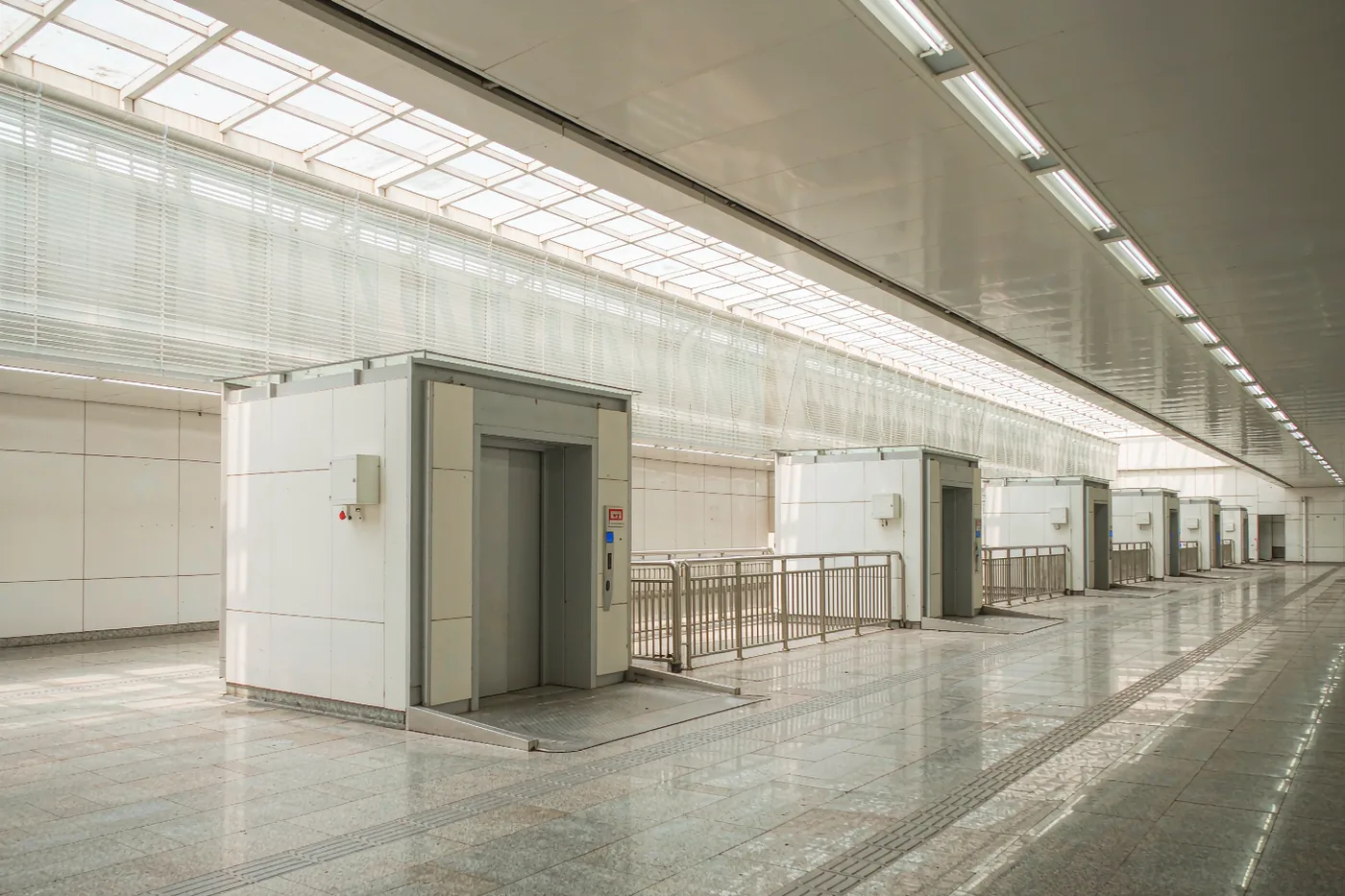
The Beijing Subway is one of the world's largest metro networks, and almost every station is now equipped with an elevator from street level to the concourse and from the concourse to the platform. That said, a few older stations on lines built before the 2008 Olympics still rely on staff-assisted solutions, so it pays to plan your route in advance.
Elevators at stations — Most stations have at least one accessible entrance with an elevator — usually marked with the international wheelchair symbol. It may be a separate entrance from the main stairs, sometimes 50–100 m (160–330 ft) away. Check station maps in the Beijing Subway app or the official website to locate the accessible entrance for your specific station. [verify before travel]
Gap fillers and boarding — Platform-to-train gaps are generally small, and many stations have ramps or gap fillers at designated boarding points. On some lines, station staff will deploy a portable ramp — stand near the marked boarding area or ask at the service window.
Fares and payment — Fares start around CNY 3 (about USD 0.40) and rise with distance; riders with recognized disabilities and wheelchair users travel at normal fare. You can pay with a transit card, single-journey token, or mobile payment. Fares are unchanged regardless of assistance needed. [verify before travel]
Staff assistance — Every staffed station has a service window. Staff speak limited English but are used to helping; show your destination station name in Chinese characters (have it written down or show it on your phone). They can guide you to the elevator and call ahead to your transfer or exit station so staff meet you there. [verify before travel]
Accessible restrooms — Larger and newer stations typically have an accessible toilet, usually near the concourse. Older stations may not — plan restroom stops around major interchange hubs.
Practical Planning Tips for the Subway
A little preparation transforms the Beijing Subway from intimidating to manageable. Here's how experienced wheelchair users and slow walkers approach it.
Use an elevator-routing app or ask — Mapping apps (Amap / Gaode, Baidu Maps) often let you filter for accessible exits and elevator locations in Chinese. If in doubt, take a screenshot of your origin and destination stations in Chinese characters and show it to station staff. [verify before travel]
Avoid rush hour — Weekday peaks roughly 07:30–09:30 and 17:30–19:30 are extremely crowded, which makes boarding and transfers stressful with any mobility device. Travel mid-morning or early afternoon if you can.
Mind escalators, not just elevators — Escalators are everywhere and elevators may require staff to unlock or activate. Budget an extra 10–15 minutes per journey with transfers, and don't hesitate to ask staff to open the elevator — it's a normal request.
Taxis and ride-hailing as backup — Standard taxis cost roughly CNY 13 (about USD 1.80) for the first 3 km (1.9 miles) plus distance charges. [verify before travel] Most taxis are sedans, not wheelchair-accessible vehicles; foldable wheelchairs go in the trunk. Ride-hailing via Didi offers an accessible-vehicle option in some cases. [verify before travel]
Beijing Capital International Airport (PEK)
Beijing's older, larger airport, northeast of the city, handles most full-service and international carriers. Terminals are connected by a free inter-terminal shuttle and the airport has comprehensive step-free routes: elevators between levels, accessible restrooms on each floor, dedicated security lanes, and free wheelchair assistance you can request through your airline when booking or at check-in (request at least 48 hours ahead for guaranteed service). [verify before travel] The Airport Express train to the city is step-free at both airport stations. [verify before travel]
Metro
Capital Airport Express line from the city; confirm current downtown departure station and any transfer changes. [verify before travel]
Opening hours
Airport operates 24 hours; Airport Express and shuttle services run on limited daily schedules. [verify before travel]
Tickets
Airport Express fare roughly CNY 25 (about USD 3.50) one way; confirm current pricing. [verify before travel]
How long
About 25–30 minutes by Airport Express to the city center; 45–90 minutes by taxi depending on traffic. [verify before travel]
Beijing Daxing International Airport (PKX)
Daxing, opened in 2019 south of the city, is architecturally spectacular and built to modern accessibility standards: level floors throughout, elevators at every change of level, accessible restrooms throughout, and wide, flat walking distances that are long but step-free. Free wheelchair assistance is available via your airline (request at booking or 48 hours ahead). [verify before travel] The Daxing Airport Express links the terminal to the city's subway network, and the terminal itself is directly connected to high-speed rail. [verify before travel]
Metro
Daxing Airport Express from Caoqiao in the city; confirm current terminus and transfer points. [verify before travel]
Opening hours
Airport operates 24 hours; Airport Express runs on a fixed daily schedule. [verify before travel]
Tickets
Daxing Airport Express fare roughly CNY 35 (about USD 5) one way from the city end; confirm current pricing. [verify before travel]
How long
About 19–30 minutes by Airport Express; 60–90 minutes by taxi depending on traffic. [verify before travel]
Accessible Taxis and Airport Transfers
If the subway feels like too much on arrival day, pre-booked private transfers are the most reliable step-free option: many hotels and third-party services can arrange a vehicle with a ramp or spacious trunk. Standard metered taxis from both airports cost roughly CNY 100–150 (about USD 14–21) to central Beijing plus tolls, but are conventional sedans. [verify before travel] Confirm with your hotel whether they can arrange an accessible vehicle before you land.
Metro
Not applicable — road transfer; both airports have step-free kerbside pickup zones. [verify before travel]
Opening hours
Taxis operate 24 hours; pre-booked transfers must be arranged in advance. [verify before travel]
Tickets
Roughly CNY 100–150 (about USD 14–21) to the city center plus expressway tolls; private accessible transfers cost more — confirm when booking. [verify before travel]
How long
45–90 minutes from either airport to central Beijing depending on traffic. [verify before travel]
Related Beijing guides
If you found this useful, these cover the next question most visitors ask:
Carry your destination in Chinese — Save hotel name, address, and destination stations in Chinese characters on your phone. This single step solves 90% of communication gaps with station and airline staff.
Request airline assistance 48 hours ahead — Both airports provide free wheelchair and escort services, but airlines need advance notice — request when booking or at least 48 hours before departure. [verify before travel]
Call the subway hotline for route planning — Beijing Subway's service hotline can confirm elevator availability and staff assistance for specific stations and times. Hotel staff can often call on your behalf. [verify before travel]
Watch for kerbs and construction — Street-level accessibility outside stations varies — dropped kerbs are inconsistent and construction sites can temporarily close accessible entrances. Allow buffer time and have a taxi fallback.
Bring a portable ramp if you use one — While stations carry portable ramps, having your own small folding board simplifies boarding independent vehicles and older taxis.