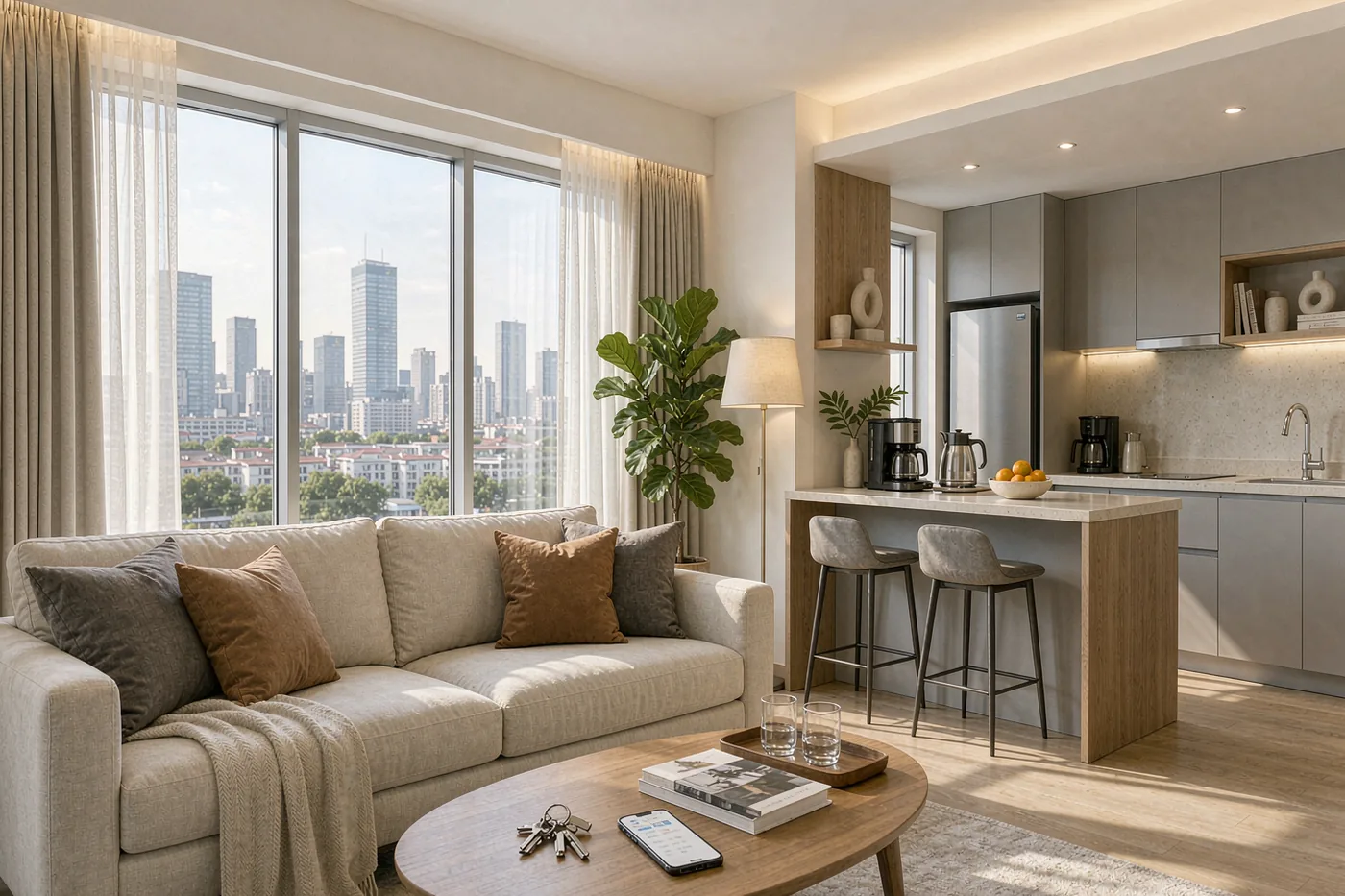
Airbnb removed all mainland listings in 2022. What replaced it in Beijing: aparthotels, minsu platforms, the 24-hour registration rule and how to avoid a midnight refusal.
Open Airbnb in Beijing and the search comes back empty. This is not a glitch: Airbnb removed every mainland China listing in July 2022 and has not returned. Apartment-style lodging still exists all over the city - serviced apartments, licensed minsu (民宿, homestays), aparthotels - but booking one with a foreign passport works differently from the rest of the world, and a police-registration rule decides whether the place you booked can actually take you in. This guide covers what happened, what replaced Airbnb, and how to lock in an apartment-style stay without being turned away at the front desk at 11 p.m.
Airbnb announced its exit from the domestic China business in May 2022 and stopped supporting mainland homes and experiences that July. Mainland listings were only about 2% of its global supply, local platforms had already taken most of the market, and the company refocused on outbound Chinese travelers. The app still installs and still works - for Tokyo, Seoul or Bangkok, and for Hong Kong, Macau and other destinations outside the mainland. But searches for Beijing, Shanghai or Chengdu return no stays available no matter the dates. There is no hidden inventory and no workaround: any "Beijing apartment" you see offered on Airbnb is either an outdated listing or an off-platform arrangement, and both are traps for a foreigner.
The rule that shapes everything here is Article 39 of the Exit and Entry Administration Law: hotels register every guest automatically at check-in, while anyone staying anywhere other than a hotel must register with the police within 24 hours of arrival, either in person or through the host. This is why some properties "cannot take foreigners" - they simply lack the registration system - and why an informal apartment listing is riskier than it looks: if your host cannot or will not register you, the obligation falls on you. The process got much easier recently: since September 21, 2026, the National Immigration Administration has rolled out online accommodation registration nationwide, through the NIA official website, the NIA 12367 app, the NIA 12367 WeChat mini-program or the Alipay mini-program, and online registration carries the same legal effect as going to a station. Offline registration at the local police station (派出所) is still available. Skipping registration starts with warnings and fines that can reach about 2,000 yuan [verify] - and beyond the fine, a missing record makes life harder later: visa extensions, some train ticket counters and future hotel check-ins all go smoother with it.
Minsu is the Chinese word for what Airbnb used to offer: someone's apartment, or a converted courtyard house, rented by the room or whole. In Beijing they split into two very different groups. Licensed ones are registered with the public security system and feed guest data into the same reporting pipeline as hotels, so they can host foreign passports. Informal ones - a landlord renting out a spare flat with no paperwork - often cannot register you at all. On Chinese booking apps the phrase 内宾 ("domestic guests only") is the tell: it means mainland ID holders only, and it is the single most common reason travelers get refused at midnight. Note that courtyard properties in the hutongs which appear on international platforms are usually licensed boutique hotels rather than private flats - that is the legitimate way to get the hutong-courtyard experience.
These are the channels that accept a foreign passport end to end, from payment to check-in:
If what you actually wanted from Airbnb was space, a kitchen and a washing machine, serviced apartments (服务式公寓) and aparthotels deliver exactly that with hotel-grade compliance: passport check-in, automatic registration, receipted payment, and often weekly and monthly rates far below the nightly price. International brands cluster in Chaoyang District and around Sanlitun; local aparthotels spread along subway lines all over the city. For any stay of a week or more, message the property directly for a long-stay rate instead of paying the nightly price online - they usually have one, and it is usually better. (We have a dedicated guide to monthly rates and negotiation in Beijing.)
Five checks that separate a real apartment stay from a midnight refusal:
A legal private stay is workable now that registration is online. Within 24 hours of arrival, either the host registers you or you register yourself through the NIA 12367 app, the NIA official website or the Alipay mini-program; the first registration goes smoother with the host assisting, because they hold the property documents. Keep the registration record on your phone: you will want it for visa extension appointments, and some counters ask for it when you book onward travel. If a host dodges the registration topic entirely, treat that as the red flag it is - walk away and take the refundable fallback.
Ballpark for a central Beijing apartment-style stay - prices move with season and events, so treat these as orientation only [verify]: serviced apartments in Chaoyang or near a subway interchange run roughly 500-900 yuan per night, and weekly rates drop noticeably; a boutique room in a converted hutong courtyard usually lands at 600-1,200 yuan; minsu in ordinary apartment towers listed on domestic platforms can be 200-450 yuan, but carry the registration caveats above. A four-star hotel room often sits in the same band as an aparthotel, so choose by what you value: kitchen and washing machine versus front desk and breakfast.